Showing posts with label Audio Review. Show all posts

Sunday, 13 June 2021

Big Finish Reviews+ The Third Doctor Adventures, Volume 7 by Tony J Fyler


“I’ve put all my eggs in the one basket.”

“Well that’s fine… supposing no-one steals the basket.”

The Brigadier and the Third Doctor there from The Time Warrior.

Ironically, the Brig is in much the same situation in the first story in this seventh Third Doctor box set, The Unzal Incursion.

Written by Mark Wright and set during the Doctor’s first, rather more spiky year as UNIT’s scientific advisor, The Unzal Incursion has a lot of the flavour of that year, with a little evolution from the 1970s. Liz Shaw (played by Daisy Ashford, daughter of Caroline John) with a frankly uncanny rightness of tone, has been leading a project to give the Earth a long-range warning system to pick up any alien wrong ’uns heading our way. As soon as it goes live, the Invasion Of The Week that was later to become a staple of the show becomes much more difficult to achieve.

Which is as good a reason as any for a bunch of alien wrong ’uns to want to knock it out or control it. The Hotspur Network, as it’s rather catchily called, becomes the focus on the Unzal Incursion, but like a lot of the best stories from the Liz Shaw season, the threat is already here. With a hint of Inferno around the edges, almost overnight, UNIT is compromised from within. Previously perfectly loyal officers go over to the enemy. And the Doctor, Professor Shaw and the Brigadier are forced onto the run, with all the forces of a hostile UNIT on their tails.

Chases in Bessie, chases in helicopters (with Lethbridge-Stewart in the pilot’s seat), sonic weapons, mass brainwashing, all the good stuff from early Pertwee-era Who is here, with a cast who frankly sound like they’re having the time of their lives. There’s an incredible zing between all the main players, Tim Treloar as the Third Doctor anchoring the piece with ever-increasing confidence and a vocal Pertwee stride, Jon Culshaw as the Brigadier sounding like he’s got the job he was born to play, and Daisy Ashford fitting in perfectly as Professor Shaw.

There’s an interesting question posed in the sub-text of The Unzal Incursion – at what point do your actions stop being your responsibility? There’s a good deal of brainwashing involved in getting UNIT to turn on its leader, and the question is raised of whether simply being brainwashed is defence enough for those who do unconscionable deeds, or whether at some point a line is drawn and responsibility allocated for not fighting a difficult personal fight to escape the brainwashing.

Along the way, there’s some excellent Liz Shawing, of the king you’d love to have seen on screen. There’s a classic Third Doctor gambit, stepping forward to be the Unzal’s ambassador to the powers that be, and there’s an utterly barnstorming performance from Misha Malcolm as Sergeant ‘Nicki’ Attah, described as a relief for Benton. We’d very much like more of Sergeant Attah, please and thank you, and ultimately, we’d like her to be Brigadier of UNIT North or somesuch, second only to Lethbridge-Stewart himself. We’d like that because Malcolm’s performance is fresh, and vibrant, and a joy to listen to, and because she feels like a paving of the way for the likes of a young Winifred Bambera to come up through the ranks. More. Please. Thank you.

In all fairness though, we could ask for more of almost everything in this story. More of the effortless chemistry between Culshaw and Treloar (adjusted slightly in this story so that it reflects that first Pertwee season with its sizing up of each other). More Daisy Ashford, any time she’s free and the stories can be written for her. And more hardcore UNIT action stories like this one, to sweep us along and make us eat popcorn as the episodes power by us one after another with a pulse-raising punch and purpose.

And then there’s The Gulf.

Two more dissimilar stories it would be hard to even devise, but you won’t be chewing popcorn listening to Tim Foley’s tale of serious psychological horror.

You’ll be too busy biting your nails.

There’s a whole different atmosphere here, as Foley takes the Third Doctor and Sarah-Jane (again played by the daughter of the original actress, in this case Sadie Miller) to an artistic retreat with several serious differences. A platform on a giant lethal ocean, occupied solely by women artists, presided over by Marta Malvani, a seemingly past-her-prime artist, who now mostly guides the works of others. In a mark of staggeringly ironic casting, Marta Malvani is played by Wendy Craig, an actress of legendary status and power, whose prime is not only here and now, but has been enduring in one form and another for decades. You could more or less stop reading once you know Wendy Craig is in The Gulf and be assured of its quality.

But there’s so much more to say. This thing is creeeeepy. Rivulets down the wall, water-monsters talking you to death, old secrets rising to the surface, complex relationship drama creeeeeepy.

Tim Foley always has a dab hand with his scripts of getting you to buy into the character-chemistry, but this is a story so immersive, so multi-faceted, you may need a good brisk walk in the sunshine once you’re done with it, just to restore your equilibrium. That’s only right for a story where the villain seems to ooze into you from the walls, from the air, from the drinking water, and from every conversation you have.

Imagine a situation where the air you breathe became both insidious and aggressive, wanting to trip you into one reaction. One obvious reaction, and then you die. Don’t blink. Don’t move. Don’t breathe…

This is a story very much in a 21st century vein, but starring the Third Doctor and Sarah. It’s very distinctly an evolution of the kind of story that could have – and would have – been told on TV during their era, but the character chemistry between the two of them remains true to that Seventies model.

It would be utter folly to try and explain all the backstory of The Gulf to you – and besides, it would ruin the experience for you. But in the foreground suffice it to say that one of the young artists on the platform falls into the deadly sea, and is missing, presumed about as dead as you can imagine.

And then she comes back.

The creepy suspicions that begin to drip into every conversation are what powers The Gulf along, and when the truth is finally revealed, it’s so very worth the wait. As with Daisy Ashford’s Liz Shaw in The Unzal Incursion, there’s at least one scene in The Gulf which is pure Sarah-Jane, of the kind you’d have paid good handfuls of salary to have seen on screen. Slightly weirdly, they’re both scenes of companion-torture. But where Liz is tortured physically, and you hear her magnificent resistance, Sarah-Jane gets the psychological treatment, and it reveals something about the relationship between our favourite journalist and her ever-absent Aunt Lavinia that will help put them both in a brand new light.

The Unzal Incursion is full-on early UNIT action adventure that will get your pulse pounding. The Gulf, by way of utter contrast, is a clammy, claustrophobic terrorfest, probably way too dark for TV at the time, but absolutely up there with the likes of The Chimes of Midnight in the sustained atmosphere and chilly finger up the spine stakes.

Both of the stories in this box set could well be thought of as masterpieces in their own right. The cast is spot on, anchored by Tim ‘Flawless’ Treloar, and you’ll come out the other side of this box set believing you’ve just been through a Third Doctor kaleidoscope of moods – and loved every minute of it.

Tuesday, 5 November 2019

Who Reviews Carnival of Monsters by Tony J Fyler


Step right up, says Tony, 
for sights unlike anything you’ve seen before…

Free from his exile on Earth, with his knowledge of time travel restored, the Third Doctor promises to take Jo to Metebelis 3 – annnnnd misses, spectacularly. In a way, this first post-exile story does what it can to reassure viewers that the Third Doctor will actually be just as hopelessly meandering in his adventures as were Doctors one and two, despite our now knowing significantly more about the Time Lords, Gallifrey and the Doctor’s relative status as a runaway. He’s not about to become suddenly competent in his Tardis piloting.

In fact, he sort of is – there’s more precise Tardis work coming up from the Third Doctor than ever marked out his predecessors, but the idea that this is not so is seeded by his utter inability, at least until The Green Death, to find Metebelis 3.

Appearing to land the ship in the bowels of the SS Bernice, it quickly becomes clear that Things Are Not What They Seem, as people’s attitudes change in a finger-snap, as they seem to re-perform different actions, and as, of course, the plesiosaurus arrives to terrorise them all.

Dead giveaway, the plesiosaurus.

To be entirely fair though, Robert Holmes has already rather blown the surprise by the time the plesiosaurus turns up, because he seems intent on giving the viewer both sides of the story – inside and out. The Doctor and Jo have been nabbed by a miniscope belonging to a travelling theatrical, Vorg, and his glittery – and also fairly brainy – assistant Shirna. They’re the only bit of brightness currently on the planet Inter Minor, where a bunch of mirthless bureaucrats are plotting treason and anarchy as a way to effect regime change on their planet. The joy of the difference in scale between the story-threads – the Doctor and Jo in real, imminent peril from the likes of Drashigs, and the bureaucrats plotting their carefully restrained treason at the hands of Kalik (played with a heightened intensity of cunning by Dalek-vocalist and eventually original Davros, Michael Wisher) – is that those on Inter Minor, while dealing with their petty treacheries, are actually doing what we the audience is doing – they’re watching Doctor Who to take a break from their lives.

It’s a format to which Robert Holmes would of course return in The Trial Of A Time Lord – external political drama, internal imminent threat and violence, watched on a screen by the big, powerful people.

As the story develops, and the Doctor and Jo manoeuvre their way about in the wiring of the miniscope, trailing Drashigs as they go, the plot strands crash into each other, and what was small becomes large and deadly, in a way which quickly spirals out of the Inter Minor bureaucrats’ control, the imminent violent threat and the droll political chicanery fight for dominance of the screen, leading ultimately to the destruction of the dangerous Drashigs, the failure of the political plotting, and the return of all the miniscope’s other prisoners to their proper times and places. All of which sounds fairly pedestrian when you simply read it.
Carnival of Monsters is anything but pedestrian. It’s more or less a masterclass in Robert Holmes’ writing style.

On the one hand, he gives just enough detail of the Inter Minorans’ political problems – there are the elite and there are a sub-class, revolting for work-breaks and food and potentially votes and suchlike tomfoolery. It doesn’t take more than a handful of heartbeats and one effective stunt to establish all this, but in just a few broad strokes, he gives us a world of complications, class struggle, and sneering politicos – you could honestly watch Michael Wisher as a kind of proto-Rees-Mogg and he wouldn’t be out of place.

Then he gives us a classic pair of ‘ducking and diving’ side-characters to add an element of plot motion and deep characterisation. As he would go on to do in The Ribos Operation with Garron and Unstoffe, and again in The Mysterious Planet with Glitz and Dibber, in Vorg and Shirna, Holmes gives us characters with a grounded, practical self-interest to power the story along and establish the major and minor scoundrel of the pair to give us light and shade. And then of course, he tosses the Doctor and his companion into scrape after scrape, fighting among the – in this case literal – little people for control of a destiny controlled by the equally literal high-ups, eventually leading to a revolution and the fall of big bad meanies. It sounds like an easy, almost basic formula, but in Holmes’ hands, it sings. It probably shouldn’t, but it does.

Quite apart from which, Holmes gives us shock after shock – the plesiosaurus attacking an early 20th century ship for one, the sudden arrival in the scope of a giant hand, almost Monty Pythonlike, which plucks away the Tardis for another, the ghastly, still-scary-forty-years-later appearance and sound of the Drashigs, and the several moments when they break through seemingly impervious environments, especially their escape onto Inter Minor – they all help to punctuate what could easily become a mundane story with moments that keep you watching. The pace at which Holmes whips his thrills and chills along also means you’re never allowed to get bored watching Carnival of Monsters – as with the miniscope from which it takes its name, there’s always something to see, something to worry about, something to enjoy.

Ultimately perhaps, that’s the secret to the success of Carnival of Monsters – it fills the screen at every moment, both with the imminent-danger narrative and the more sedate but still threatening political shenanigans outside the scope. And while in later stages  it feels like the wheels should come off the storytelling as there’s almost too much going on, without slackening the pace at all, Holmes keeps all the lines of storytelling relatively clear, so you hang on in there, invested, biting your nails to the quick, hiding behind a cushion when the Drashigs come on, and only relaxing at the very end when all the drama’s done. And the fact that the Doctor and Jo go down among the scope-folk to show us the unfairness of caging living creatures for the amusement of others means you can even read Carnival of Monsters as a treatise on both the likes of Victorian freakshows, and on the wrongness of imprisoning wild animals in circuses and zoos, making them perform for an astonished and fee-paying crowd.

Carnival of Monsters is definitely an off-beat Doctor Who story, especially considering that it follows the likes of The Three Doctors, and comes after a longish dry spell of mostly Earth-bound adventuring. But a solid script from Holmes, some gloriously interesting casting – Michael Wisher as Kalik, Lesllie Dwyer as Vorg, Tenniel Evans as Major Daly and Ian Marter as Lt Andrews to name but a few – and the outstanding work of the modelmakers and sound effect department that combines to make the Drashigs a devastatingly memorable monster of the Pertwee era mean that although it doesn’t exactly ‘fit’ into any era of Doctor Who, you can never ignore or dismiss it as a lesser story. Carnival of Monsters always rewards a re-watch – the concept is clever, the writing is textbook Robert Holmes and the Drashigs live on in the collective memory of Who-fans as an almost quintessential creation of the early seventies.

Tuesday, 5 February 2019

Who Reviews Marco Polo Audio Book by Tony J Fyler


Tony gets saddle sores.


Written by John Lucarotti.
Read by Zienia Merton.

Marco Polo has a strange place in the fans of Doctor Who fans. It was only the fourth story broadcast in the very first season, back in 1963, and except for some faffing around with some entirely notional cavemen in An Unearthly Child, it was the first example of a kind of storytelling that was initially at the absolute heart of the Doctor Who concept: the ‘pure historical’ story, where the only dangers that the Tardis crew encountered were the people and the forces of history with whom they tangled. It was part of the original remit of the show to entertain its audience while teaching them things about history and science, and while the spacefaring side frequently illustrated some scientific principle or other, history was to be illuminated by taking the crew into pockets of the Earth’s own past and seeing how they survived.

Quite apart from which of course, the BBC had a glorious reputation for costume and historical drama, which meant you could cut down costs on props and costuming if you turned Doctor Who into a historical drama for a handful of weeks.

By – at the very most – the end of the Second Doctor’s time in the Tardis, the gloss had rather worn off the pure historicals, and only once more in the Classic era, and never quite yet in New Who has the Tardis team tangled with just the forces of history (although maybe you could argue for Demons of the Punjab….). But the first season of the show was rich in these historical epics – after Marco Polo, Season 1 also gave us The Aztecs and The Reign of Terror.

John Lucarotti wrote both Marco Polo and The Aztecs, and subsequently novelised them both. The audio version of Marco Polo has taken until 2019 to reach us, and sadly, it’s an oddish affair.

Already in its fundamentals rather heavier on history and lighter on actual adventure than The Aztecs, Lucarotti in the novelisation seems almost determined to downplay the character interactions that – from listening to the audio of the episodes, as the visuals are sadly missing – we know added life and colour to the broadcast version. The idea that the Tardis travellers get caught up in Marco Polo’s journey to Kublai Khan, and that Polo determines to give the Tardis to the Khan as a gift (*cough, cough* bribe) so that he can stop pratting about all over the orient and go home to Venice is robust, and easy to buy. The inter-tribal or interpersonal politics that see warlords plotting to kill our time travellers, and even establish themselves as the new Khan, feel like they bubble along more or less to fill pages, and when they finally come front and centre, never hit with the same dramatic force as for instance Lucarotti gets into the Aztecs novelisation’s climax. The friendship between Susan and the young Samarkandian lady Ping Cho – in the broadcast version something of a milestone in the first season, as Susan was marked out early as belonging nowhere in the Tardis dynamic, too young to equal her grandfather, and indeed too ‘young’ even to avoid occasionally being patronised by the Earth schoolteachers, and yet too old to really ‘fit’ into that childlike niche – is rendered in a mechanical way, leaving the listener feeling robbed of the bubbly dynamic of the two young actresses, even when one of them, Zienia Merton who played Ping Cho, is the reader here. A somewhat better, more comical job is done of rendering the twinkly relationship between the Doctor and Kublai Khan, two old men with old men’s complaints and a shared interest in gambling games (though Lucarotti at least in retrospect does the Doctor the service of suggesting he may be putting on the ‘old man with a bad back’ bit so as to forge a friendship with the ageing, gout-ridden ruler). More than all of this though, the fact that most of the drama of Marco Polo takes place on the trip to see Kublai Khan allows Ian, Barbara and, somewhat perversely, Marco Polo himself, to fade into the background, so in the end, your chief abiding memory of the story in the novelization isn’t of the sumptuous visuals, or the dashing eponymous character, but of a long commute in a caravan with some argy-bargy and a monstrously convenient Richard Curtis love story along the way.

Oh, and a sense of suddenly craving Chinese food. Seriously, the meals in the Marco Polo novelisation will make you drool, because Lucarotti, robbed of much of the set dressing of the TV broadcast, really goes to town on the descriptions of the succulent morsels our team get to sample along their journey, as a key to evoking the ‘otherness’ of the orient in a positive light. There’s little sense of the slog, the challenges, the drama of would-be assassins, but if you finish the audio-novel without feeling like you could really go for some crispy wontons, you’ve been lulled into unconsciousness by the descriptions of the journey, and you need to go back and have a re-listen.

Zienia Merton, it must be said, reads the story with a youth and lightness in her voice that belies the fact that it’s over five decades since she played Ping Cho, and her Doctor too is suitably gruff and twinkly by turns, allowing him to shine here as he did in the original broadcast version. The issues that make the audio version of the novelisation drag are in the writing itself, as Lucarotti fails to punch the peril home with enough vigour to make the story much more than ‘Travels With Marco.’ It’s still fun to travel with Marco of course, and Merton is absolutely key to bringing that out of the novelisation, as she was in bringing it out of the script, but the book, and so the audio-novelisation, feels sadly lacking in the grandeur that made the TV version worth creating in the first place.

Sunday, 18 March 2018

Who Reviews The Ark by Tony J Fyler


Tony mucks out the Monoids.

Doctor Who has always been a show driven by imagination and stories, rather than practical deliverables and budgets. That means there have always been stories that, while working brilliantly as stories, have been let down by wobbly sets and naff monsters.

The Ark, from First Doctor William Hartnell’s third season, is one of those stories. At its core, The Ark is a brilliant tale - humans fleeing the destruction of the Earth by the Sun, taking all the animals with them, along with micro-dotted human beings and a friendly bunch of mute creatures called the Monoids. It takes in themes of privilege and revolution and also, deals with the consequences of the Doctor’s interference in time and space as the Doctor’s companion Dodo bring a cold on board the spaceship. Having no resistance, the super-evolved crew start dropping like flies. There’s a trial, there’s the Doctor in scientific mode trying to find an antidote, and then, job done, the Tardis crew bog off into time and space – only to return immediately to the Ark 700 years later, to find the Monoids no longer mute, no longer docile and frankly ruling the roost. It’s not quite Planet of the Apes, but it is rather Spaceship of the Monoids.

Sadly, the Monoids on-screen reduced The Ark to ‘that one with the stupid one-eyed Beatle-haired things.’ They were badly realised on what felt like an aggressive level, and they robbed the story of any real ability to shock or provoke.

Good news! The audiobook version means you can invent your own Monoids, albeit they’re described in the text. Your mind has a bigger budget than the BBC in the Sixties, and so the Monoids, while still being front and centre of the action here, stop being so much of a focus-drag.

The audiobook by Paul Erickson manages to take a four-part story that always on screen felt like two two-parters knitted together (two episodes with the humans in charge, followed by two on a Monoid-run Ark), and expand it to feel like a valuable six-parter, with a long trial as the Doctor and Co are sentenced to death for bringing a fatal disease on board the Ark, and some exploring in different environments and biospheres to find vaccine ingredients. There’s more texture to the novelization than ever made it on screen too – we learn how Monoid One came to power, which gives a rewarding reality to the revolution of the Monoids, and we also get a bit of backstory for Jackie Lane’s Dodo.

The Ark then feels like a more substantial story in the novelization than it did on screen, and its themes are given more time to expand and bed in.

Peter Purves, on reading duties, is perfect here. His Steven, the companion he played in the story, is of course perfect, but he also delivers a Dodo that makes you want to dig out more Dodo stories and watch them, and over the last decade, at Big Finish and BBC Audio, he’s been honing his version of the First Doctor to the point where it’s utterly believable and consistent, meaning he strongly anchors Doctor Who stories that need a nuanced characterisation of the First Doctor to hold them together. Even his Monoids sounds less distracting than the on-screen versions, helping you to get away from the visual of them, and making the run-time of this audio novelization fly by.

Pick up The Ark on audiobook today – it’s probably the best version of this story you’ll ever own.  

Sunday, 31 May 2015

Reviews The Sin Eaters by DJ Forrest


Read by Gareth David-Lloyd
Written by Brian Minchin
ISBN: 978-1-408-42621-0

Torchwood has been receiving a few unidentified blips recently which fade after a few minutes, but this time they have a lock on them.  Jack, with Gwen and Ianto, the last three surviving members of Torchwood Three take the short cut down to the shore where they uncover a dead man covered in deep abrasions caused by an unknown source. 

Another beachcomber is on the beach that night, gathering up the source which enables his congregation to repent their sins and worship to their last breath.  The Reverend Haywood has plans for these creatures who grow with each sin in his font.  He has plans to deliver his message across the city of Cardiff, but the creatures have their own agenda…

The Sin Eaters audio read by Gareth David-Lloyd is a two CD story written by Brian Minchin.  Gareth known for his role as Ianto Jones, gives a good impersonation of Captain Jack Harkness, Rhys, his own character Ianto and Gwen.  Gareth puts deep feeling into his narration, you can feel the pain and the suffering of the characters that are touched by the larvae.  You can imagine the look on Ianto’s face after Puska falls out of the sky and Jack’s wit at various moments during the 2 ½ hour story. 

The story is after Series 2 but before Series 3 – the team are still in the Hub in Cardiff.  Jack introduces Ianto to a few surprises in the Hub that even ‘archive boy’ hadn’t been aware of, and Ianto introduces Jack to a few he didn’t think Ianto knew about.  It’s quite funny listening to the pair when they head out to sea.  Brian writes in such a way that you can’t help wishing that you could visualise the story in an actual episode, although given the level of CGI that would need to be involved, it could be quite a pricey episode at that.  But there are just a few scenes you wish you could see, to know that facial expressions count for a lot when you’re trying to visualise it for yourself, and I really want to see creature in the tank and the mother of all creatures rising out of the sea, and Jack, and Ianto and Puska!

I have to also admit that the picture on the front cover doesn’t convey what I imagined the fully formed larvae to turn into.  I was hoping for something far more alien than that, perhaps along the lines of alien dragonflies rather than hover flies, but that’s imagination for you. 

I have a wide selection of audio stories read by various cast members of Torchwood and although every single one of them are fantastic at their role, I can honestly say, that out of all of them, I would rather Gareth and Kai narrate.  There is something about these two men’s narrations that nail it for me on all levels especially their level of enthusiasm for the story.  I physically jumped out of my skin when Gareth yelled earlier on in the first half of the story.  I wasn’t expecting that!

Currently this is my favourite of all my Torchwood audio stories, and I do have a fair few now, although admittedly, a lot are digital downloads which I will at some point update to CD format. 

Published by BBC Audiobooks Ltd in 2009, if you haven’t heard it yet, then it’s a must buy. 


Tuesday, 1 October 2013

Who Reviews The Greatest Show in the Galaxy by DJ Forrest


Written by Stephen Wyatt
Narrated by Sophie Aldred
Published by AudioGO Ltd
Running Time: 4hrs 44min
Number of CDs: 4
Release Date: 01/08/2013
Complete and unabridged novelisation

The Greatest Show in the Galaxy is as you may have guessed – a circus, but inside the tent with the sawdust and the audience are circus folk you will have never seen before.

This story features the 7th Doctor and his companion Ace and they’re on their way to a psychic circus on the planet Seganax, a wilderness of a place, barren landscape, where kites (not the birds) are deployed to search for those who may have escaped from the circus.  A hearse driven by the Chief Clown is called out to collect the runaways with his team of robot clowns.  You see once you enter the circus, you can never leave!

There are two characters, Bellboy who is a robot repairer employed by the circus, and there’s Flower Child who is in love with Bellboy, and they escape but the kites with eyes painted on them fly into the sky in search of the runaways, and when it sights them, it sends a message through to the hearse and the clowns are deployed. Bellboy knows he will never outrun the kites and acts as a decoy in order for Flower Child to escape.

There are many characters within the story, including a proud biker called Nord who is also a little stupid, but they’re all going to the Circus, to perform their acts in front of an audience of three!

Sophie Aldred really has her work cut out in this story, as I said, there are many characters, so obviously many voices and she does it so easily, throwing a Scottish accent for the Doctor, Ace’s gruff stubborn voice, then the deep grumpy accent for Nord, then there’s Bellboy and Flower Child and many more besides.

The audio story was written by Stephen Wyatt, who also wrote the novel published by Target Books in 1989.  Stephen also wrote and novelised Paradise Towers.
It’s an extremely long audio story – 4 CD’s in total, and it’s very easy to get lost in the midst of it, but stick with it.  I’ve never been a fan of the 7th Doctor, but this story I found interesting, and Sophie’s interpretation of the characters helped to cement that.


Sophie Aldred is a British actress and television presenter best known for her portrayal of the Doctor's companion Ace from 1987 to 1989.  Sophie has also performed on radio and in theatre, reprising her role as Ace in a charity special Dimensions in Time and the Doctor Who audio plays produced by Big Finish Productions.  

Friday, 27 September 2013

Who Reviews The Greatest Show in the Galaxy Audio by DJ Forrest


By Stephen Wyatt
Complete and unabridged novelisation
Narrated by Sophie Aldred
Published by AudioGO Ltd
Running Time: 4hrs 44min
Number of CDs: 4
Release Date: 01/08/2013

The Greatest Show in the Galaxy is as you may have guessed – a circus, but inside the tent with the sawdust and the audience are circus folk you will have never seen before.

This story features the 7th Doctor and his companion Ace and they’re on their way to a psychic circus on the planet Seganax, a wilderness of a place, barren landscape, where kites (not the birds) are deployed to search for those who may have escaped from the circus.  A hearse driven by the Chief Clown is called out to collect the runaways with his team of robot clowns.  You see once you enter the circus, you can never leave!

There are two characters, Bellboy who is a robot repairer employed by the circus, and there’s Flower Child who is in love with Bellboy, and they escape but the kites with eyes painted on them fly into the sky in search of the runaways, and when it sights them, it sends a message through to the hearse and the clowns are deployed. Bellboy knows he will never outrun the kites and acts as a decoy in order for Flower Child to escape.

There are many characters within the story, including a proud biker called Nord who is also a little stupid, but they’re all going to the Circus, to perform their acts in front of an audience of three!

Sophie Aldred really has her work cut out in this story, as I said, there are many characters, so obviously many voices and she does it so easily, throwing a Scottish accent for the Doctor, Ace’s gruff stubborn voice, then the deep grumpy accent for Nord, then there’s Bellboy and Flower Child and many more besides.

The audio story was written by Stephen Wyatt, who also wrote the novel published by Target Books in 1989.  Stephen also wrote and novelised Paradise Towers.

Sophie Aldred is a British actress and television presenter best known for her portrayal of the Doctor's companion Ace from 1987 to 1989.  Sophie has also performed on radio and in theatre, reprising her role as Ace in a charity special Dimensions in Time and the Doctor Who audio plays produced by Big Finish Productions.  

Sunday, 1 September 2013

Big Finish Reviews+ Spare Parts by Christopher Fain


Spare Parts
By Christopher Fain


Audio Drama by Big Finish Productions
Written by Marc Platt
Release date July 2002
Length 2 hrs 1 min

We all want immortality, says Thomas Dodd; he's cynical but not wrong.

It's Doctor Who at its science fiction best, the disparity of technology capable of cybernetic augmentation set in a 1950s Londonesque city locked down with rationing and curfews and cyber-Police on cyber-horses. Spare Parts is, to a newbie, a good place to start with Big Finish's Doctor Who audio drama line. The Cyberman voices are a throw-back to the television serial "The Tenth Planet" and that is continuity at a grand, scary level.


Intending to take Nyssa to the picture show in London, the Doctor has accidentally brought her to the wrong place. Not an unusual occurrence, but this time it could have larger repercussions than those usually faced by the time traveler and his companions. They have arrived in an underground city on Mondas, the lost twin of Earth, where the Cybermen were first created.  They're just in time to witness the last gasps of humanity on a planet where the surface is lethal and its people are being used up as a form of cannon fodder.

Here we find one of Big Finish Productions' most thought-provoking audio dramas, penned by Marc Platt. Spare Parts is a terrifying and darkly gritty tale set on Mondas, where the computerized committee government now enforces totalitarianism in the interest of survival.

Once he suspects the truth of where they are, the Doctor is sure he doesn't want to be involved.  Getting involved means changing the course of Cyberman history. To do so does not mean preventing their creation, but any alteration could result in a far worse trajectory than the one which both the Time Lord and his companion have been witness to. There are consequences to interfering with known events.

As the Doctor explains at a later point in the story, arguing with Nyssa about why they should stay disinterested: 'Sometimes you play. Sometimes you sit on the sideline. Sometimes you run afterwards with a stretcher.'

Unable to turn away immediately, they separate to explore on the cusp of the city's curfew and are caught up in the gears of Mondas' last days as a human world.  The population is doomed with disease, slow starvation, and the threat of a nebula which hangs ready to devour the frozen planet.

There is a black market for flesh body parts and the Police have been secretly ordered to dig up the cemetery, to provide the city with nutrients. Few of the processed Cybermen are surviving more than a week as their bodies reject the cybernetic augmentation. The propulsion system used to give the planet some means of directed travel is located on the frozen surface, needing crewmen for repairs and operation. Workers who go to the surface don't survive very long; even when protected by heavy gear, their minds cannot endure the terrible blackness which is their open sky.

Once again, the Doctor gets involved in saving the Cybermen, this time very much against his will. His physiology is mapped as the template for a new and improved cyborg, one that can survive the rigors of the surface. 

Mondas was perhaps doomed from its start. The people have lived in underground cities for a very long time, the planet's surface a mystery. Life on the surface is now memorialized in the ceremonies and trimmings of a holiday which seems to be similar to Earth-based Christmas but with symbolism that accents the differences between Earth and Mondas. For the Mondasian, the decorated fir tree is a reminder of an unremembered time when they lived on the surface, where the trees grew; the fairy lights are stars and the star at the top of the tree stands in for a long-lost sun, the star Sol.

They have reached an untenable position in their society. The people are dying out, fighting mortality with life-saving augmentations such as replacement hearts. Drifting in space, away from the light and heat of a star, the surface of Mondas is physically lethal and psychologically devastating. 

In this story, there is no central enemy to fight. These are organic beings with emotions and frailties. This is a war for survival in the hands of those who no longer have human feelings. With the Cybermen, the desire to survive subsumes personality and all other flesh needs into programmed responses. In the push for the survival of Mondasian humanity, they kill what it means to be human.

Spare Parts is full of easily understood characters both rich and colorful who turn the story into historical science fiction, ghastly and heart-wrenching by turns. The average citizens are like frightened rats, scurrying to be safely indoors by tea, when the curfew starts.  They are so like Earth humans that the listener cannot stay detached. The city might look like 1950s London, but it has social tones of an earlier era, with wartime rationing, curfews, and call-ups for recruits who are waved off with cheers and pride to their new job on the surface work crews. Many suspect what is really happening to those who go off for processing, but it is easier to pretend ignorance and accept the dictates of a secret government.

The Hartley family, who represent the average citizens of Mondas, clings to life on short rations and little hope, turning the telly up when a neighbor begs for help as she is collected by the Police. They sound like they're from the north of England, as dirt-common as Yorkshire. They decorate for the holiday, worry over a sluggish pet cyber-bird, fret over what to have for tea, and live in an interconnected unit which relies heavily on each beating heart---even when one of those hearts is an augmentation complete with turning paddles. 

Dad Hartley is a mat-catcher who has, at some point in the past, lost his wife. He apparently sold her body to a black marketeer; this doesn't make him a bad man, only one desperate to take care of his children. He's a brilliant, world-weary character who has become fatalistic in the face of encroaching doom.

Yvonne Hartley's a sweet and innocent teenage girl who works in the hydroponic factories, where the food is grown. She has breathing problems and a young man whom she fancies; she's as normal as any woman of her age can be and it's easy to admire her pluck and generosity of spirit, which makes her fate particularly touching. The one character who does not anticipate or deserve such a frightening end is the one character with whom you walk the queue for processing. Stripped of clothes and confused among other recruits, Yvonne only comes to the realization of what processing truly means as the knives and laser saws begin to flash.

Frank Hartley wants to be recruited for service but is also ignorant of what it means. He thinks there's honor and a steady pay packet to be made by joining the surface work crews. Frank's frustratingly jealous of his sister, Yvonne, for being given her call-up papers, and it's the listener who knows what Frank does not yet understand. This is no honorable service but a death sentence given for no other reason than Yvonne's suffering from consumption.

The true horror of this audio play comes from within their home, in one of the most heartbreaking scenes ever written for a Cyberman story. If your loved one was turned into a Cyberman, would you want to see them again? Would you want to know? What if they turned up at your door only half-processed and schizophrenic with the mental torment of an incomplete conversion, incapable of remembering their humanity but childlike in their need for you?

Other secondary characters who flesh out this tale include Thomas Dodd, a wide-boy who runs a body parts shop, trading in misery and spare transplant materials. He's an opportunist, but he isn't alone; Mondas has only one underground city left and its population has shrunk to a few thousand. Dodd won't be the only one capable of seeing the truth and working to make a profit while a profit is possible.

The city is run by a Central Committee, twelve of Mondas' finest minds hooked into a computer.  They are aided, primarily, by those who still possess the physical bodies necessary to carry out the gruesome task of conversion. 

Doctorman Allan is an alcoholic scientist who is responsible for the creation of the Cybermen race, but she is no John Lumic or Davros; she is human and hates herself for what she's done to her people. She has stripped the humanity from living Mondasians and her conscience is pricked by this; she spends much of the story drinking and it is, in fact, her wine which offers the Doctor a chance at stopping this metal march to doom. Allan is every bit the cynic that Thomas Dodd, the black marketeer, is. But while Dodd is working to supply body parts to the little man for a profit, Doctorman Allan has a grander goal of saving the world. 

She is assisted by Sisterman Constant, a selector. The selectors move among the remaining population, choosing the sick and damaged for processing. She takes pride in her position and is aware of its implications. Sisterman Constant believes she is doing good and is sanctimonious about her duty. Her blindness to the inevitable outcome is painful; she can only see the present need and not how this situation must eventually play out. In this way, she can be likened to the kapos of WWII concentration camps, a judas goat.

Commander Zheng, a processed Cyberman in charge of the surface work crews, answers directly to the Central Committee; without emotion or human thought, he acts as he is ordered to and begins the job of processing the full population with an intent of shutting down the city; there is no more choice, because the roof of the underground cavern is opened, letting in the frozen atmosphere from above. He is the instrument by which Mondas' destiny is fulfilled and his last line is just as chilling as the Central Committee/Cyberplanner's repeated cries of 'We must survive'. Zheng, despite being an emotionless Cyberman, lingers in the mind as strongly as any of the unprocessed human characters and reveals to the listener that, in the end, the Doctor's involvement has changed little.

Even if the sight of this legendary Doctor Who alien doesn't frighten you, the idea behind their existence should. The mesh of a human desire for survival with the cold logic of the machine should be enough to scare any living soul. A species of cyborgs whose most basic ambition comes from within its human origins: the drive for survival, at any cost, even the loss of humanity.  How far are we from a similar fate? A breast implant today, a hip replacement tomorrow, a new nose in a few years, cyberthetic limbs for the wounded soldier returning from war, cyberthetic eyes which contain a camera and a connection to the visual center of the brain...what's next? A neural augmentation for wifi? 

The push for physical, emotional, and social perfection can be a killer.

This audio drama has been influential in the Doctor Who television show, beginning with the parallel world episodes "Rise of the Cybermen" and "The Age of Steel", which see the Doctor witnessing the birth of Cybermen on Earth in another universe. But, this is not where the influence ends. In the episodes "Army of Ghosts" and "Doomsday", the director of Torchwood One at Canary Wharf, is named Yvonne Hartman (close enough!) and she retains some of her humanity after conversion, enough so for us to draw a correlation to Spare Parts' Yvonne Hartley's uncompleted processing and the human behaviors which both Yvonnes show from under the Cyberman mask.

Many fans comment on how difficult it is to understand the Central Committee's voice, claiming it to be garbled and distorted. It is true that this particular voice is hard to follow at times, but given that the character is, story-wise, meant to be a composite of twelve brains joined together through a computer, the Central Committee's voice(s) is just about what a listener should expect. 

Spare Parts is a masterpiece of storytelling, a captivating dystopic history for one of the Doctor's greatest foes.

_________________________________________________________


Art used here comes from:
http://alphabetswhop.blogspot.com/2013/05/c-is-for-cybermen.html

You can find this audio drama at:

Marc Platt is a British writer well known for his contributions to Doctor Who. He has written twenty-one Doctor Who audio plays for Big Finish Audio. He wrote the 7th Doctor television serial "Ghost Light" and five Doctor Who novels, including the much-acclaimed Lungbarrow.  Spare Parts was the inspiration for the 2006 Doctor Who episodes "Rise of the Cybermen" and "The Age of Steel".

Directed by: Gary Russell
Sound Design: Alistair Lock
Music: Alistair Lock
Cover Art: Clayton Hickman
Number of Discs: 2
Duration: Disc 1 (59:08) Disc 2 (73:50)
ISBN: 1-903654-72-6
Recorded: 26 & 27 March 2002
Recorded At: The Moat Studios
Chronology: This story takes place between the 5th Doctor's television adventures Time-Flight and Arc of Infinity.


Cast:
The Doctor --Peter Davison
Nyssa --Sarah Sutton
Doctorman Allan --Sally Knyvette
Sisterman Constant --Pamela Binns
Thomas Dodd --Derren Nesbitt
Mister Hartley --Paul Copley
Yvonne Hartley --Kathryn Guck
Frank Hartley --Jim Hartley
Mrs. Ginsberg --Ann Jenkins
Gary Russell --Philpott/Nurse
Alistair Lock --Minister/TV Commentator
Nicholas Briggs --Zheng/Cyber Voices/Radio Announcer/Citizen/Nurse

(Paul Copley also appeared as Clem McDonald in Children of Earth)

Monday, 1 July 2013

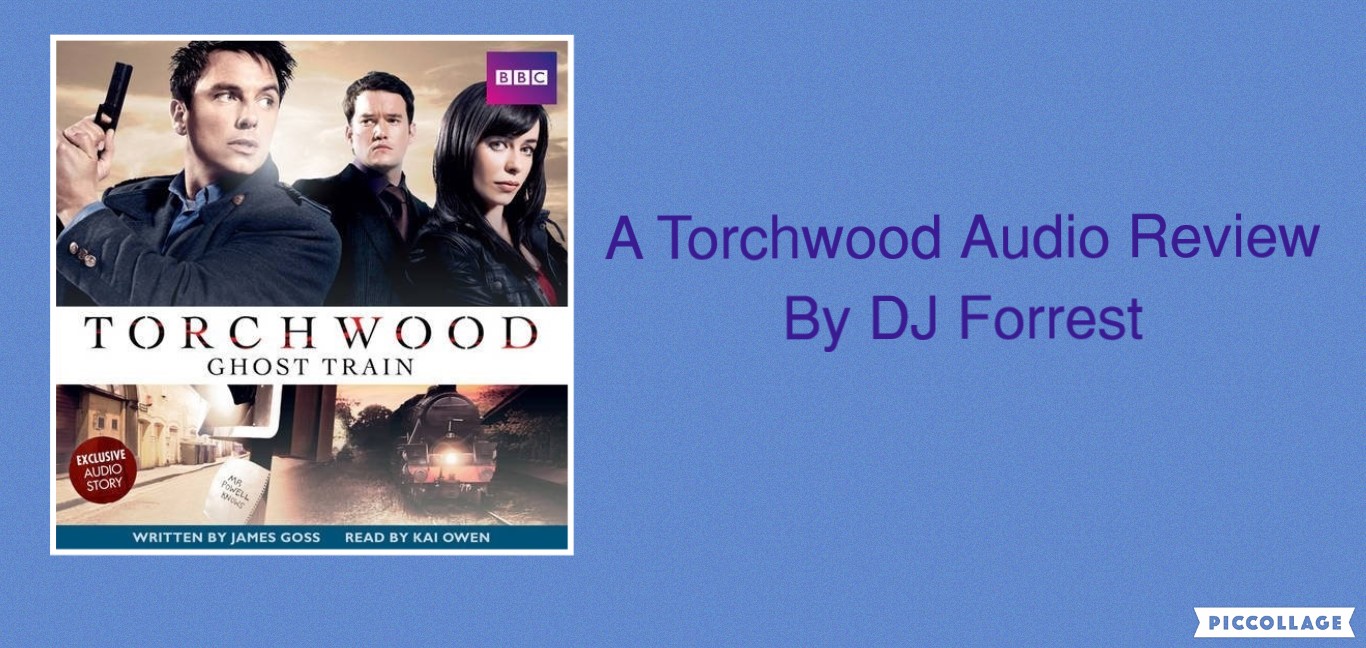
Reviews Ghost Train by DJ Forrest


Read by Kai Owen
Published by AudioGo Ltd
Release date: 1st March 2011
Written by James Goss

There’s something strange falling from the skies and Torchwood are dealing, but there are also some strange occurrences at Harwood’s Haulage in the shape of fridges.  It’s not just Rhys who’s noticed.  But can he get a moment to talk to his wife Gwen about it, because with the strange occurrences there’s also the train that shouldn’t be arriving on Platform One, and while Gwen has to deal with a matter regarding her husband, Captain Jack Harkness also goes missing.

So Rhys becomes Sherlock Holmes and does a little deducing of his own. 

It’s a fascinating and often funny story that has all the qualities you expect from a Torchwood story with the added quality of Rhys Williams. 

The instant Kai Owen speaks you know you’re not going to do anything else but listen to the story.  Whether it be the Welsh accent or the fact the story is written especially for Rhys, but the moment Kai speaks, all other work ceases till the story ends. 

I found the story entertaining and have listened to it several times already and it doesn’t get old.  I want to hear more stories read by Kai Owen who has a firm grasp of Gwen and Ianto’s voices and Captain Jack Harkness.

‘Ghost Train’ is set before Children of Earth and features Captain Jack Harkness, Ianto Jones, Gwen Cooper and Rhys Williams and read by Kai Owen.

It was especially written for audio book by James Goss and runs for 2 hours.


Tuesday, 7 May 2013

Reviews Torchwood: Red Skies by Steve Taylor-Bryant


Praise be to Torchwood.


Written by Joseph Lidster


Red Skies is a Torchwood Audio Drama from the pen of Joseph Lidster (The Sarah Jane Adventures, Wizards vs. Aliens).

Set After Miracle Day, we find Captain Jack in desperate need of a holiday. He heads for Cotter Paluni's World, a planet surrounded by lightning and cut off from any communication with the rest of the Universe. Jack finds a couple of problems though 1) the planets inhabitants are worshippers of Torchwood and 2) he gets arrested for murder!

Red Skies is around an hour long and once you get past the disappointment that none of the questions raised by Miracle Day are going to be answered, it is a great listen. There are plenty of references for fans, and an awful amount of humour in the narrative.

The vocal talents of John Telfer are a welcome break from having ex-cast members narrate as is usual with branded audio dramas and he fleshes out the characters very well.

More Captain Jack than Torchwood but different in this case means good.

Monday, 6 May 2013

Reviews Torchwood: In The Shadows by Christopher Fain


Torchwood: In the Shadows
by Joseph Lidster
Produced by Heavy Entertainment
BBC Audio release 7 May 2009
read by Eve Myles


'Ring-a-ring-a-roses, a pocket full of posies.  A-tishoo!  A- tishoo!  We all fall down.'

Set between the second series' episodes of 'Meat' and 'Reset', the audio book of 'In the Shadows' sees the Cardiff Hub team once more facing the afterlife question.  Is there nothing beyond death but a black and lonely void or is there something moving in the dark?  Either of these might be preferable to what waits in the shadows.

Narrated by Eve Myles, best known to fans as Gwen Cooper, this audio production is, at two and a half hours long, fast-paced action from the start while still giving small, intimate glimpses into the minds and hearts of its characters.  We are both reassured of what we know about them and then given new perspectives that add to the larger arc of Torchwood's second series.  Myles has a beautiful voice and she gives each character their natural intonations to the best of her vocal abilities.  The incidental music used reflects the intensity and urgency of the mission, while the use of one character to tell the story through the lens of an open letter to her dead team mates gives 'In the Shadows' a reflective tone which elicits both sorrow for the loss and hope for the future.

We are given a glimpse into the Cooper-Williams pre-marriage dynamic from the beginning of the story, as they are shopping for new settee cushions when a call from PC Andy Davidson interrupts their moment of domesticity.  He's got a body, a suspect, and an impossible murder.  It's all a bit Torchwood.

The body is really a skeleton and it was found on Queen Street, Cardiff's main pedestrian shopping area.  This unusual find appears to be that of a seventy-year old man who, according to his dental records, is actually Stephen Ballard, a young professional who went missing two days previously.  The suspect in custody was the last person to see him alive.  Mousy beta-man Darren Sowersby has no memory for what happened but knows that he last saw his friend in the taxi they were sharing on the way home from an evening of post-work drinking. 

Torchwood gets involved. 

When a second body, that of a young woman named Jade Russell, turns up on a Queen Street club's dance floor, the same circumstances are present.  Alive, she was in her twenties but at death she's eighty-something and her body is in a state of decay which suggests she's been dead for a while. 

What's happening here?  What does it have to do with huon particles?  Is there a serial killer on the loose in Cardiff, destroying people with something otherworldly and malignant?  Where did this form of death come from?  Is it Torchwood-created and now in the hands of a mentally-ill human with a desire to rid the world of its sin?  Here we have no rampaging aliens, no Weevils to track and trap; the danger comes from within the dark corners of the human psyche, a place we should all fear.  Who knows what lives in the heart of the person sitting beside us on the bus or the train?  Are we being judged by those around us, stranger and friend alike?  What happens when we're found lacking? 

Just when you think the team has caught up with the unlikely villain, whose invisible presence in life gives him the perfect opportunity to punish those whom he sees as sinners, things go pear-shaped.  Jack is sent to hell.

'Silence.  Darkness.  Alone in a world of shadows, Jack Harkness had no idea where he was.'

The team works to find and retrieve Jack, well aware that hell for someone who can't die is perhaps the most monstrous fate of all.  Jack's longevity gives them time to find a solution, but if they fail to do so, Jack's stay in hell will be eternal and he has so many regrets to re-suffer through.  While Owen and Tosh handle the technical aspect of huon particles and the weapon of choice, Gwen and Ianto pry answers out of their perp, an enigmatic psychopath who believes he's doing God's work by releasing the angels to punish those mundane and unlucky sinners who cross his path.

As seen in second series' episodes, Jack and Ianto's romantic relationship at this point is developing; there is an acknowledgment of bondage play with handcuffs and safety words but it's a tease, leaving you to wonder which of them was holding the keys.  They are physical with one another and the L word is tossed out.  Jack is his flirty and bigger-than-life self, while Lidster's Ianto is sweet, funny, and a bit innocent but deeply intuitive into the workings of the human heart; his darker side, revealed on occasion to great effect, casts him in chiaroscuro which both startles and excites. 

For the sake of brevity, Owen and Tosh are not fully involved here, but not every story can showcase every character.  Even so, their place in the mission is important; each plays a role in both dimensions, as team members who are working to solve the problem and as thorns for Jack's experience in the shadow world of hell, where he is urged to think that he's gotten it all wrong about everything.

Captain John Hart makes a momentary and appropriately slimy appearance to show us how Jack fears the intrusion of his less-than-noble past.  Hart's tiny place in the story comes laced with a mental image of Ianto Jones which is haunting far longer than the fifty seconds it takes within a track full of glimpses into what life might be like for the team if Jack was well and truly dead.  There are also a few cameo appearances for characters from the background of both Torchwood and its parent television show, 'Doctor Who', such as Trinity Wells from AMNN.

Jack's realization that things are not as they seem comes after the listener has started to see that our hero is not behaving like our hero; that, in fact, he's crossed a line into darkness.  Hell, for Jack Harkness, only truly begins when he has lost everything and everyone he cares about and he knows there won't be an end to his lonely penance.

This is a story that, once you have heard it, may keep you awake at night with questions that are raised by its premise and its execution.  Is hell a real place and, if so, is it another dimension where your venial, work-day sins and miseries are exploited and used against your heart?  Even in the end, Gwen Cooper doesn't know and neither do we and maybe it's better that way, for hell is personal and subject to individualization.

When we think about what hell is, we give it many definitions.  Hell is unique for each of us, no matter what we've been taught in faith or school or by our families, and we experience it in small doses every day.  Stephen Ballard's hell is the experience of being totally alone in a silent world while Jade Russell's is a reversal of all the hateful gossip which she indulges in.  Jack's is the unending nightmare of being completely on his own in the Hub, having destroyed and forgotten everyone that he cares for.

We all have little darkly bitter and hateful thoughts about the people around us, the tiny irritations sparked by perceived slights enacted by those who are seemingly unaware of how they get under our skin.  We resent their good luck and their happy endings, as Tosh resents Gwen's and as Owen resents Jack's.

With grin-worthy cultural references like 'murgatroyd', free DVDs that come with the papers, the Rob Dougan song 'Furious Angels', the movie 'Silence of the Lambs', and other titbits, the story is firmly grounded in what we love about Torchwood.  It's 21st century (where everything changes), its immediacy is poignant, and we can identify with the beta personality who feels like they are forever second fiddle, the eternal wingman.  Always a bridesmaid, never a bride.  But, as Ianto Jones and Toshiko Sato prove, sometimes it's the little people who save the day.

Through the eyes of our beta-man Darren Sowersby, the listener is left to wonder if it is technology or the human heart's ability to forgive which saves Jack from what he fears the most.

Joseph Lidster is also the writer of the second series episode 'A Day in the Death', a fan favorite for its glimpse into hope, despair, and freedom of choice from the perspective of a dead man.  To date, he has contributed several pieces to the Torchwood paradigm as well as to other television shows such as 'Wizards vs Aliens', and 'The Sarah Jane Adventures'.  Other audio-based works include scripts and stories for Big Finish Productions' lines such as 'Doctor Who', 'UNIT', and 'Dark Shadows', to name but a few.  Fans of his 'Torchwood' stories should definitely check out other projects and offerings from this author.