Showing posts with label Mark Gatiss. Show all posts

Thursday, 5 April 2018

Beyond the TARDIS Bafflegab: Blood on Satan's Claw by Tony J Fyler


Tony’s feeling devilish.

Waaaaaaaaaaaaaaaaaaaaaaaaargh!

(Sigh). Thank you. Just needed to get that out of my system.

I used to be a horror fan. These days, I’m older and less fearless, and so it’s quite possible that horror stories will just give me the screaming heebie-jeebies.

Spoiler alert: Get some heebie-jeebie insurance before you listen to Blood On Satan’s Claw, adapted from the 1971 movie by horror writer, and on the basis of this, scary git, Mark Morris, and released by Bafflegab. Get as much heebie-jeebie insurance as you can afford, frankly, because this thing gets you coming and going.

The weird thing is it absolutely shouldn’t work.

It’s a story of 17th century rural folk, and it’s pretty black and white in its worldview: God is good, and represented by the forces of the Establishment. Satan is evil, and real, and represented by sex and violence that slip their bounds and infect society. It’s more or less The Archers meets Hellraiser.

There’s no real way that should scare the pants off us in the 21st century. We’re a relatively secular society these days, all grown-up and cynical and sneering at the nature of ‘the Devil.’
This audio works. It works jussssst fine, thank you very much.

It works because it strikes enough modern notes and balances them against the classical to deliver a taut drama of the edge of things – 17th century good and evil might be its primary colours, but there’s a modern sensibility in evidence here: teenage sexuality, innocence and experience are all on display as part of the fight for the soul of the village, along with peer pressure, the unrestrained ambition of the young, the potential effect of grief as a portal to ‘dark forces.’  

That’s the thing. If you’re scared of devils and demons, this’ll scare the pants off you. If you prefer your horror modern and rich, vivid and psychological – this’ll scare the pants off you. Either way, the chances are, you’re going to finish this one shivering and pantless.

Where Blood On Satan’s Claw is most successful is in its atmosphere – from early in the story, Angel and Margaret, (the two leaders of the revolution of the young which forms the backbone of the story here), flaunt their sexuality to Mark (one of a few avatars of corruptible and incorruptible youth), and you’re constantly waiting for the other shoe to drop, for the tease of terror embodied by their ‘worldly’ knowledge to materialise into the actual, outright horror of action. It doesn’t under-deliver either – there are a handful of sequences which are truly gruesome or sickening to contemplate, including at least a couple of killings, and a whispery children’s demon-summoning ceremony. But it’s in the self-assurance of ‘devilish’ characters, chiefly Angel and Margaret, that the tension is stoked – their knowledge of ‘worldly’ things, the easy scorn they pour on the strictures of 17th century society and establishment, and the resonances of that power with the sexualised youth of our own day and age, make them very compelling devils to follow.

Mark Morris’ Blood On Satan’s Claw delivers more than two hours of a world going mad from the bottom up, in a production that bristles with fear both ancient and modern, and keeps you constantly on edge, waiting for the next episode of ghastly, demonic bullying to come and put you through the wringer.

On the strength of this release, we can only look forward to further upcoming dabbles with classic horror – watch out soon, as Bafflegab brings Clive Barker’s The Hellbound Heart to audio life. After this adventure into the heart of youthful darkness, we say bring it on! Just let us invest in some heebie-jeebie insurance first.

Sunday, 28 September 2014

Who Reviews Night Terrors by Tom Clarke


Series 6 Episode 9.
Written by Mark Gatiss


Possibly one of the creepiest episodes of Who, next to Blink and the more recent episode Listen. So, let’s delve into the story of this episode.

The Doctor travels to a small apartment block to make a house call after his psychic paper receives a message from a young boy named George, an 8 year old who is terrified of...well, everything. So, after the Doctor, Amy and Rory arrive at the council estate, they go separate ways to try and find George quicker. After finally finding the right flat, the Doctor, taking the guise of a social worker, meets Alex, George’s father, while Claire, his mother, is on Night Shift at work. The Doctor soon learns that little George has been scared all his life, but handles it by “metaphorically” putting the fears into his wardrobe.

Meanwhile, Amy and Rory, fall unconscious in a lift, but soon wake up in a strange house, which looks like it was from the 18th Century. They soon discover that the props are wooden, the pans, cutlery, everything, as if they were in a doll house. They see some of the council estate residents in the house, but they are shortly turned into human size creepy Peg Dolls. Amy and Rory witness another transformation and try to hide behind a door, but Amy is taken and transformed into a Peg Doll, joining the hunt for Rory.

Back in the flat, the Doctor opens the wardrobe, to find its contents are just toys and clothes. The Doctor tells Alex that in the pictures leading up to George’s birth, Claire wasn’t pregnant,  which in turn caused Alex to remember the fact that Claire was unable to have children, and thus, how could she have a child? Plot Twist? Well, luckily, the Doctor is here to explain it all.
 The Doctor asserts that George is a Tenza child, an empathic alien who took on the form of Alex and Claire's desired child through a perception filter and has the ability to literally lock away his fears within the wardrobe. George panics from this revelation and sends the Doctor and into the dollhouse. As the dolls descend on the three, the Doctor calls out to George and tells him to face his fears; George is finally able to open the wardrobe and appears in the dollhouse, but right in the middle of all the dolls. After the dolls turn and ascend on George, The Doctor realises that George is frightened that Alex and Claire plan to send him away, though he had misinterpreted a conversation they had earlier that night between Alex and Claire.  Alex rushes through the dolls to embrace George as his son, and tells him he will never let him go. This seems to free George, and everyone appears back where they belonged, Amy and Rory in the lift, and The Doctor, Alex and George in the flat, all happy and safe. Claire returns to find George happy and not scared. The Doctor meets back up with Amy and Rory, and they all set off for their next adventure.

The writing in this episode is great, and the tension of the fact that Amy and Rory could become dolls at any point, and they have no idea what that means. If they were turned, could they turn back? Or were they dead forever? Another great thing about this, is that it’s more of a companion episode, where Amy and Rory can take the spotlight. The Doctor isn’t in danger until the last 10 minutes of the episode where he is sent into the dollhouse. The Doctor’s adventure in this episode was finding out what scared little George, and why. I also have to praise the actor who played George, and did it wonderfully, and he makes me wish that he could return for a future episode. The last bit of conversation between the Doctor and Alex hinted at the fact he could return, maybe during George’s teenage years, maybe to see how he’s doing.

There are a few problems with this episode; the fact it adds nothing to the plot of the series, and it was just a standalone episode (though this is a great example of showing how great a standalone episode should be), and the fact that this episode was meant to be Episode 4 instead of Episode 9 of the series, but was delayed as it felt “too dark” this early in the series. That is fine, but the hinting towards the death of the Doctor at the end of the episode felt tacked on and just didn’t feel right. The episode had no foreshadowing to the death of the Doctor and it just felt...out of place, and finally, though I praised the actor who played George, I wish he was in the episode a bit more. The episode had three focuses: The Doctor and Alex, trying to find out what is up with George, Amy and Rory in the Doll House and George being scared, and having a few lines. Those few lines in the episode were great, and whenever he interacted with any other character, you could feel the terror going through him. But if there was a bit less Alex and Doctor, and a bit more George, that would have made the episode even better.

A great episode written by the ever great Mark Gatiss, who has written for Doctor Who before, and co-wrote the brilliant BBC One series Sherlock.
7/10

Tuesday, 9 September 2014

Who Reviews Robot of Sherwood by Jeffrey Zyra


By Mark Gatiss
Series 8

“Shut it, Hoody!”

Being a fan of Robin Hood I was somewhat lukewarm to the prospect of Doctor Who doing an episode centered on him and Sherwood Forest and the overall Robin Hood legend. That and the writer for this episode was Mark Gatiss who has been really hit or miss with his stories.  In Series 7 he wrote the good “Cold War” and the very bad “The Crimson Horror.” So he now delivers to us his next story “Robot of Sherwood” and from looking at the trailers it could be one that could very well be uneventful and not all that good.

Well I have to say that I surprisingly actually liked and enjoyed “Robot of Sherwood.”   Robot of Sherwood was an episode that did not take itself seriously and that is why it worked as a Doctor Who story.  Sometimes Doctor Who has to be funny and light hearted especially when you are going in the direction of being darker.  Robot of Sherwood fit that bill very well and it also wasn’t overly silly. Well maybe it was a tad silly.  At times it felt like a Black Adder episode.  I could see Rowan Atkinson doing the scenes in the dungeon where Robin Hood and The Doctor were chained to each other.   Those scenes were pretty good and were performed really well by Peter Capaldi and Tom Riley.  In fact this story was pretty funny and found myself laughing through it a lot which doesn’t normally happen when you watch Doctor Who and for it once it was ok to have a story this different and funny and I am glad they tried something different again this week.

If you are a fan, as I am, of the Errol Flynn “The Adventures of Robin Hood” which came out in 1938 you’ll be happy to see a lot from that movie made it into this episode.  Like the fight on the river and the archery contest it was all there. If you’re going to do a Robin Hood episode you do need to have some of his familiar exploits.  Even the fight at the end of with the Sheriff of Nottingham was sort of in the same vein as the one from the Errol Flynn movie.  I did like the sword fight at the beginning.  The Doctor using the spoon and bragging on how he was trained by the best was pretty funny and you knew how it would end up.  It was funny seeing The Doctor getting pushed into the water after beating Robin Hood with the spoon.  What shouldn’t go unnoticed is that there is also a cameo by Patrick Troughton as Robin Hood from when he played him in the 1953 TV series which in itself was pretty cool thing to see.

I could see “Robot of Sherwood” fitting in the Tom Baker era. In fact it kind of reminded me of that era when I was watching it.   It had that type of feel to it with the comedy and then seriousness.  Especially when The Doctor is confronting the Sheriff and trying to deduce his plans and saying a bunch of silly nonsense that does not make sense and then figuring it out that is was nonsense.  That was purely a 4th Doctor moment.  Plus just the way The Doctor presented himself made it feel like a 4th Doctor story especially with him bragging about Robin Hood not existing and then seeing the arrow go into the TARDIS.  It sure looked like Peter Capaldi was channeling his inner Tom Baker.

The story on a whole was pretty simple.  Robots have crashed landed on Earth and using the habitants as slaves to help repair the ship. This time using them to collect gold and melting it down so it can be used into making new circuits for the ship so it can continue to the promise land.  Not a very original idea and one that has been done before in Doctor Who and in fact better than “Robot of Sherwood”.  But it was till enjoyable and did not really detract from the fun of seeing Robin Hood and The Doctor interacting and bickering with one another.  Have to say the robot knights looked pretty good and I thought they were pretty neat especially when they revealed their faces. 

Jenna Coleman was again in top form and was really good in this story.  Clara as a character has grown a lot from being the impossible girl to what she is today.  She is actually using some brains in figuring out the plan by tricking the Sheriff and she also has no problems of being really sarcastic to The Doctor.  I like her being sarcastic to The Doctor as it works really well and works well with Peter Capaldi as there is really good chemistry there.  

Robot of Sherwood is a story that I had low expectations going into and ending up enjoying it.  It was a story that did not take it self all too seriously and in the end it ended up being very entertaining and funny which comes as a nice change of pace for Doctor Who.
Grade B +


Saturday, 26 April 2014

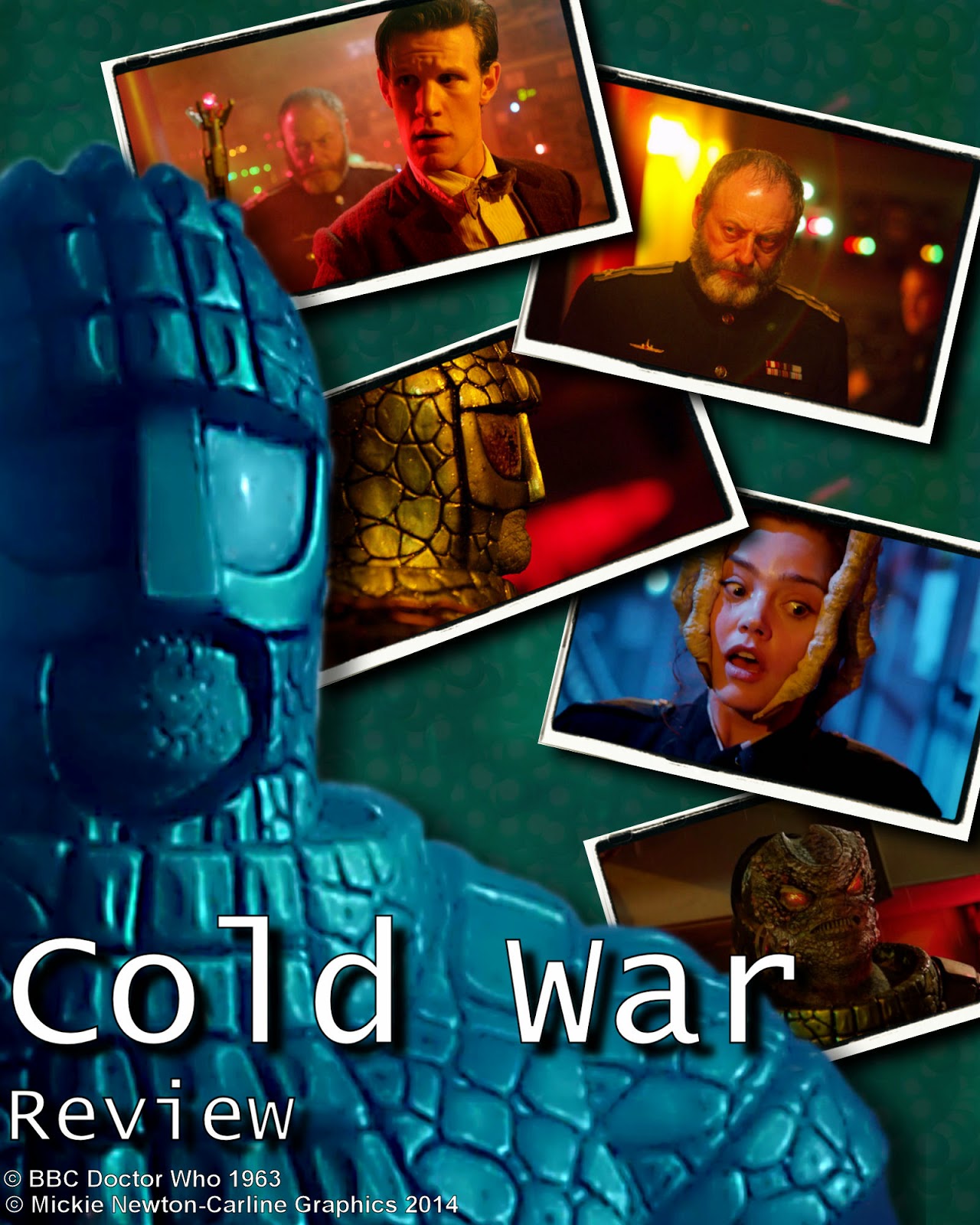
Who Reviews Cold War Review by Steve Taylor-Bryant


Written by Mark Gatiss
Directed by Douglas Mackinnon
Broadcast 13 April 2013
Series 7
Reviewed by Steve Taylor-Bryant

A Soviet submarine in the early 80's begins to defrost an ice block it believes contains a Mammoth but it contains something much more evil. The submarine starts to sink and the defrosted creature escapes as the TARDIS materialises and a surprised Doctor and Clara stumble out to find they are not in Las Vegas where they were actually heading. The Doctor quickly gets his bearings and convinces the crew to take the submarine sideways to prevent a crash and a nuclear explosion.

The Doctor comes face to face with his old enemy The Ice Warrior in the guise of Grand Marshall Skaldak and begs the Russian crew to act in peace but one of the officers attacks Skaldak. With revenge being on Skaldak's mind, the Doctor and the crew chain up Skaldak whilst the Doctor tries to work out the next move. Skaldak activates a homing beacon knowing his race will find him.

Clara volunteers to talk to Skaldak and, with the Doctor’s words, explains that he has been frozen for five thousand years. Skaldak is sad for the loss of his people and in particular his daughter and escapes his suit. Martian law means the whole of humanity is responsible for an attack on the Ice Warrior and he arms the nuclear weapons ready to destroy the Earth. An Ice Warrior ship appears above the surface, pulls the submarine up and beams Skaldak aboard. In one last attempt at peace, the Doctor begs Skaldak to spare the humans and eventually Skaldak disarms the nuclear payload.

I was so excited to see the Ice Warrior come back into Doctor Who. The last time they had appeared on screen was 1974 and I was still a year from being born, so it had been a while. I am also a huge fan of Mark Gatiss and thought such a fan of the legacy of Doctor Who would produce something epic. However, I was very wrong and left disappointed with what was essentially a Dalek rewrite. The chance to do something special with a classic villain of the older days of Who was surely missed.

©BBC Doctor Who 1963

Thursday, 30 January 2014

Beyond The TARDIS Sherlock: The Empty Hearse by Jeffrey Zyra


Written by Mark Gatiss

Well it has been two years since Sherlock jumped off that building and has been thought to be dead by the person he associates with and that includes his best friend John Watson.  Now that he has returned from the dead and being away from London for two years to shut down Moriarty’s network Sherlock has returned.  In two years things have changed and people have gotten on with their lives and how will they react to Sherlock returning to their lives.  Well it has indeed been a long time since Sherlock has been on television and The Empty Hearse has been one of the most anticipated stories for a long time.  Did the resolution to how Sherlock faked his death satisfactory and what about the story itself which fans have waited two years for did it stand up to all the hoopla surrounding it?

Well yes and no. The Empty Hearse didn’t have the feel of a typical Sherlock episode.  It just didn’t seem like the mystery was all there.  Sherlock comes back to stop a terrorist attack and he just seems to stumble into finding it out.  After he reconciles with John the pair seem to hunt for a subway car that is missing and could be a bomb.  What they discover is that it is a bomb and that Sherlock does not know how to disarm it.  But what this scenario really does is get Watson to admit he isn’t really mad at Sherlock any more.  What seemed to be a letdown is that the bomb was disabled by an off switch.   This part of the story just wasn’t as good as the previous six stories.  It just seemed to be anticlimactic and was pretty much a throw away sequence which only accomplished the reconciliation of the two friends and hopefully things will be more like Sherlock of old in the mystery department.

What I did like was seeing all the theories of how Sherlock could have faked his death.  My favorite one was with the mask of Sherlock on Moriarty and Sherlock bungee cord diving into the window and kissing Molly goodbye.  What has me wondering is did we actually see how he did it?  It did seem to be hinted at that we would not know even when he told Anderson.  Even still this was a pretty clever way that they did it and it keeps you guessing.  I’m sure the way it happened was how he told it to Anderson and how many spotted the Doctor Who reference when Sherlock activated the plan.  The code word was Lazarus the same character Mark Gatiss played in The Lazarus Experiment.  I wonder how many of the fans deduced how he did it and got it correct.

I did like how Sherlock revealed to Watson he was back and not dead.  It was pretty clever seeing him disguise himself as a waiter and then making the reveal.  But you did have to feel for Watson because it was at the point that he was going to propose to Mary.  What was funny was how long Watson kept it together before he started punching Sherlock. I think I would have punched him the minute he revealed himself.  Also like the two other attacks Watson did to Sherlock at two different restaurants with my favorite being the head butt. This part of the story was good seeing how the two friends were getting along without each other.  We see Sherlock spending the day with Molly investigating crimes and we see Watson being incredibly bored at his practice.  I liked this part of the story and would not mind if the story took on this for the most part of the story with the conclusion being Sherlock and Mary saving Watson at the bonfire.  Then they could be wondering who did it and that could have been a good set up for the rest of the series.

After being away for two years it was really good to see Sherlock again.  The Empty Hearse gave us a glimpse of Sherlock that we have not seen before actually showing emotion and being pleasant to those he works with.  The fact he gave Molly a kiss is something and the fact he realized he missed his chance with her is something we have not seen and we see more of this when he is talking with Mycroft later on while playing deductions.  We see a resolution to what happened two years ago and now the gang is back together again.  The Empty Hearse was entertaining if somewhat not up to standards in the mystery department but that does not really detract from what was the main focal point of the episode which was the reconciliation of the old friends and how much they need each other more than they are willing to let on.  The Empty Hearse was a triumphant return for Sherlock and hopefully the mystery will be more prominent in the next two stories.
Grade B +


Sunday, 1 December 2013

Who Reviews An Adventure in Space and Time by Jeffrey Zyra


Written by Mark Gatiss


When the news came down that they were planning on making a docudrama about the origins of Doctor Who and the man who was the torchbearer for The Doctor William Hartnell I was more than intrigued. In fact you could say I was really excited to see this docudrama and at times I wanted to see this more than “The Day of The Doctor.”  Then the promotional pictures were released and I saw how closely they paid attention to detail just made the excitement level go up to a whole new level.  Now I really wanted to see “An Adventure In Space and Time” and see how the show came to fruition and the hardships it came up against.

Now I have finally watched “An Adventure In Space and Time” and I am lost for words on how magnificent it was.  Watching the origins of the show unfold before my eyes was incredible.  As most fans have only read about this we now can see what happened and more importantly some of the events that made up the origins of Doctor Who.   It was interesting to see Verity Lambert and Waris Hussein fight through the prejudices of the time. What makes the show that more incredible is the barriers it broke by having the first woman producer at the BBC.  This is normal for the times as sexism and racism was still strong back then and nothing was done about it like today.  Mark Gatiss did an excellent job getting the feel of that era right down to the cigarette smoking which was a common thing back then.

I really was impressed with the sets and costumes.  The production crew really paid attention to detail and it all looked like it did back in 1963 especially the Daleks city on Skaro.  That looked amazing along with the sets they used for Marco Polo and The Web Planet.  The costumes too were top notch and pretty accurate.  It was amazing to see the sets and costumes as they really did a great job on them.  But what was most impressive was how the TARDIS came about.  Watching that scene on how they made the basis for it was pretty interesting and then when you saw the set itself it was absolutely stunning.  It looked just like the set they used for the William Hartnell stories and it was just amazing to see as it was so breathtaking to see when they unveiled it for the first time.

David Bradley was an excellent choice to play William Hartnell.  He had the look and the mannerisms down pat.  It was like watching William Hartnell himself on the screen.  David Bradley brought the man to life and in ways that many fans probably did not know.  The way he showed us the true man and not the actor that we see on TV was good to see even if some of it wasn’t pleasant.  There was also a sense of sadness with William Hartnell as you could see as the years went on and the people he enjoyed being with left the show.  The saddest was when they told him they didn’t want him to be The Doctor anymore and you just felt sorry for him.  It was a very sad moment especially when he got home to his wife Heather and started crying that he didn’t want to leave the show.

Even though William Hartnell was a grumpy and difficult old man and hard to work with he did have a charm to him that was shown in “An Adventure In Space and Time”.  Like when he went off on Carole Ann Ford and then realized he was a jerk and made up for it by apologizing to her by buying her flowers with an apology in the card.  The scene that I really liked the most and one that really defined the man was when he was approached by the school children when he was sitting in the park with his wife.  I smiled watching him marching with the children and yelling exterminate.  That was a sweet scene and a side of William Hartnell that most people do not know.

Mark Gatiss gave us an absolute masterpiece about the beginnings of Doctor Who. From Sydney Newman coming up with the idea of Doctor Who right down to the regeneration with Patrick Troughton.  It was true to form and was not sugar coated to put things in a better light and duplicated an era that not many fans know about.  It was funny, sad and heartwarming at times and I’m sure it brought a tear to a lot of the older Doctor Who fans like myself.  “An Adventure In Space and Time” was a really good anniversary present for the fans and I myself truly enjoyed watching it.  I also loved the surprise of seeing Matt Smith at the end smiling and nodding to David Bradley’s William Hartnell giving him a sense that what he started still goes on to this day and that was really a great touch to end the docudrama on.

Thank you Mr. Gatiss for giving us a wonderful movie to watch over and over and it is indeed a wonderful present for the fans.
Grade A +


Photo Source

©BBC Doctor Who 1963