Showing posts with label Consequences. Show all posts

Saturday, 1 June 2013

Interviews David Llewellyn for Consequences by DJ Forrest


David Llewellyn is a Welsh novelist and script writer and was born in 1978 in Pontypool.  He’s written quite a few stories for Torchwood, ‘Trace Memories’ (2008), ‘Consequences – The Baby Farmers’ (2009) and short stories for the Torchwood Yearbook – Mrs Acres (2008), and for the Torchwood Magazine – The Book of Jahl (2008), and I May Be Some Time (2009).  Quite recently David wrote a Torchwood audio play read by Tom Price called ‘Fall Out,’ He has also written two Doctor Who novels, ‘The Taking of Chelsea 426’ which featured the 10th Doctor, and ‘Night of the Humans’ featuring the 11th Doctor and Amy Pond.

The Baby Farmers

One of the things I found very comfortable about your story was how quick the piece came together, how descriptive the story was that I found myself in that ‘driving rain and howling wind’  with Mary and her baby.  The other thing I liked about the story was it was well before Gwen and Ianto and the rest of the team we’ve come to follow in the series, it put it right back to the early days when Emily Holroyd and Alice Guppy were in control, and I liked that. 

When you put the story together between the five of you, had it been a conscious choice to start the story off, and was it your decision to set it in this era?

David: Well, actually, the real genius behind ‘Consequences’ was our editor, Steve Tribe. The idea to do a kind of “portmanteau” book, with five interlinking stories, was his idea, and he corralled us all together.

I think he and I had had a conversation, after I’d written my Torchwood novel ‘Trace Memory’, about how much fun it might be to write expanded universe stories set in the past, and when he was planning ‘Consequences’ he asked if I’d like to write a story about Victorian Torchwood.  Well, I almost bit his hand off at the chance!

After that, it was just a case of running it by the Powers That Be (who are understandably cautious about sanctioning anything that might conflict with continuity at a later date), and getting the permission of Chris Chibnall, who created the 1890s Torchwood characters Emily, Alice and Charles.

If it were possible to write another Torchwood story, would you set it back in the 1800’s or would you choose a different era?

David: Funnily enough, Steve and I discussed this not long afterwards, some time after ‘Children of Earth’ was televised, and I seem to remember saying I’d like to do either another Victorian one, or perhaps one set in the 1930s, but that was about as far as it went!

It did surprise me however that as ever in Torchwood that the leader of the organisation was having same gender relations with another of the team.  Almost like the female version of Captain Jack with her Ianto, as it were.  Was this something that you as a writer already knew about the two female characters or was this something you’d decided on for the story?

David: I think it had been alluded to in the series 2 episode ‘Fragments’, so I just went with it! But yes, it does make a nice counterweight to all the man-on-man action that’s going on in present-day Torchwood!

How long did it take to put the story together, and were you working on a deadline?

 David: I honestly can’t remember how long it took to put it all together. Probably a sign that I’m getting old, but in my defence this was almost 4 years ago! Based on my experience writing other stuff for Doctor Who and Torchwood, I can imagine the deadline was probably not long after I’d agreed to write it! As for writing it, I don’t think it took very long for me to bash out a first draft. Probably only a couple of weeks. Then it’s usually the case that you play tennis with your editors, bouncing it back and fore until either it’s good to go or you’ve all run out of time!

I liked the description of the HMS Hades and wished I could see it for real but then wondered if it were related to any of the tall ships that have been in Cardiff Bay?

 David: HMS Hades was actually based on two ships that were once docked in Cardiff; the Hamadryad, which was used as a naval hospital, and the Havannah, which was used – like the Hades – as a ragged school, a kind of orphanage-meets-borstal for wayward boys. I’d seen black and white or sepia photos of both ships, and they were both a little creepy-looking, particularly the Hamadryad.

You’ve written a few stories for Torchwood, have any of these been adapted for audio play/book?

David: The only one that’s been recorded as an audio was written specifically to be recorded, and that was ‘Fallout’, which was read by Tom Price (aka Sgt Andy). That was quite recent, following on directly from ‘Miracle Day’, and was focused almost entirely on Sgt. Andy. I’d love to do more stuff like that, stories set on the fringes of the Torchwood universe, but one of the most common complaints about ‘Fallout’ from listeners was that it didn’t have enough Torchwood in it, so maybe there isn’t much appetite for that sort of thing!

When you were writing The Baby Farmers, what was the best part in the story for you?

 David: The joy of writing something for a book is that you don’t have to worry about a budget. Scriptwriters for the series are always aware that everything they write costs money, and that some things cost more than others, but with a book or a short story, a description of an explosion doesn’t cost any more than a description of somebody crossing a room.

With everything I write, for Doctor Who or Torchwood, I try and include at least one moment that would be ludicrously expensive to film, so that it feels a little bit special. With The Baby Farmers, that scene was probably the moment when Torchwood charge across Cardiff’s Tiger Bay on horseback. It feels very cinematic, and was certainly exciting to write, so I hope it’s exciting to read!

Are you working on any projects at the moment that you’d like to share with Project: Torchwood? 

David: Well, I’m not working on anything Torchwood-related as that all seems to be on hold at the moment. I have recently written an episode for the second series of The Confessions of Dorian Gray, an audio series starring Merlin’s Alexander Vlahos in the title role. Obviously, Dorian is immortal, sexually ambiguous, and in the series has adventures across the 20th Century, so there are some similarities with Torchwood there, I guess!

Other than that, I’ve just put the finishing touches on a novel called ‘Ibrahim & Reenie’ which is out in autumn, but that’s a very different type of story altogether! It’s about a 75-year-old woman and a 24-year-old man walking from Cardiff to London.

Do you attend any of the Cons up and down the country or those overseas? 

David: I haven’t, not really. I did attend Alt. Fiction in Derby a couple of years ago, where I got to meet some other Torchwood novelists, including Mark Morris and Consequences’ very own Sarah Pinborough, but I haven’t really done much conventioneering. I never seem to get invited! I must have some sort of scandalous reputation…

Do you have a blog or a site that the fans can follow you from aside from Twitter?

David: Yes, I’m on Twitter as @TheDaiLlew, and I write an occasion blog about films, TV, and books at   

www.aforestofbeasts.wordpress.com     

Special thanks to David Llewellyn for the interview and to wiki for the information source


Interviews Sarah Pinborough by DJ Forrest


Sarah Pinborough born 1972, in Milton Keynes is an English horror writer whose works have been compared with such writers as Dean Koontz, Richard Layman and Bentley Little.  Under the name Sarah Silverwood she also writes fantasy novels for children with the Nowhere Chronicles.

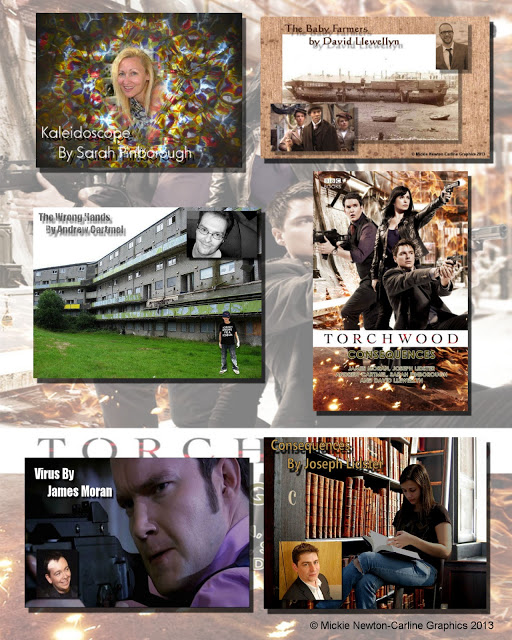
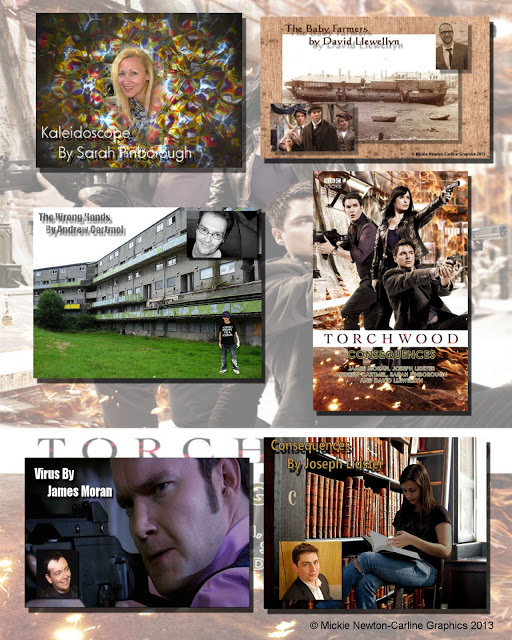
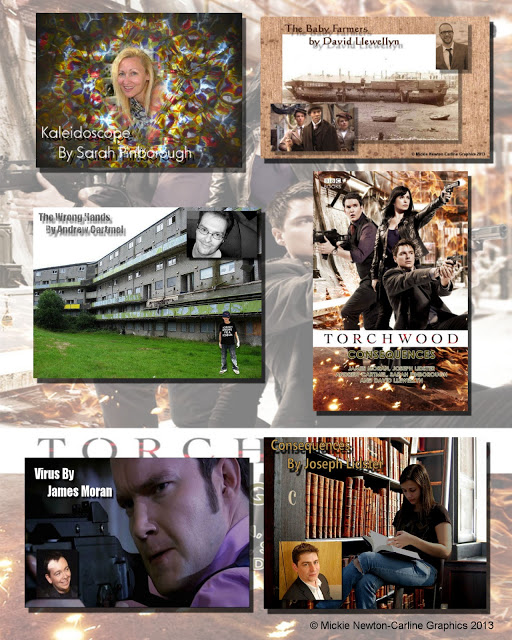
Sarah has written two Torchwood novels ‘Into the Silence’ (2009) and ‘Long Time Dead’ and also wrote ‘Kaleidoscope’ for the ‘Consequences’ novel, that also features short stories by David Llewellyn, James Moran, Andrew Cartmel and Joseph Lidster.

Sarah also wrote the 2nd episode of the 9th Series of New Tricks ‘Old School Ties’ (2012),  the crime drama starring James Bolam, Dennis Waterman, Alun Armstrong and Amanda Redman.

In 2012 it was announced that director Peter Medak had been attached to direct ‘Cracked’, a screenplay based on Sarah Pinborough's first novel ‘The Hidden’.

Recently Project: Torchwood interviewed Sarah Pinborough in connection with her story Kaleidoscope for Consequences and about her new projects and book launches.


I liked the feel of this story from the point of Danny Dillard, a lad who didn’t have much and had that feel good factor with the kaleidoscope, and how it changed even his dad, but it was the twist at the end though when things didn’t quite end as you hoped.  I loved your description of the boy and his life, had you based those characters on anyone you knew?

Sarah: No, I rarely base characters on people I know, but I had worked at a school on quite a tough estate for a few years so that probably fed into it a bit.

What prompted the idea of a kaleidoscope for the Rehabilitator?

Sarah: I honestly can't remember! Although it seems natural for it to be something you look through that distorts things. I'd probably looked through one close to the time I had to come up with the story or something.

Your story Kaleidoscope would have occurred when Jack went off with the Doctor and just before he returned for Series 2 in Kiss Kiss Bang Bang?  It did seem odd not seeing Jack coming into the story, but having the four other members working harder to prove themselves.  Was it harder on yourself to have all four members to operate in your head and on paper?  All talking to you at once.

Sarah: No, not really. In the novels I have all five of them – well, at least in Into the Silence. In Long Time Dead it's mainly just Suzy's narrative. The thing with writing tie-in novels is they tend to be quite dialogue focussed because you're emulating the show, and so it's more natural to have them all talking and the flow just comes. They have very separate voices and as most of the people reading the books are already very familiar with the characters you don't have to spend a lot of time establishing them.

You’ve just launched your new book ‘Poison’ – congratulations on the book, have you always been interested in the genre you write for or has this developed over the years?

Sarah: Poison (to be followed by Charm and Beauty) is a departure for me. I normally write crime/horror/fantasy/sci-fi style stories so re-working fairy tales has been quite different. But I've enjoyed doing them and fairy tales are a type of fantasy. Plus, there are some quite dark elements in mine.

I’ve been toying with two different styles of writing, first person which always had me struggling but has somewhat worked on a new story – horror piece in fact, and another which is third person omniscient which I prefer to write as, do you vary your writing styles, or favour one over the other?

Sarah: I tend to write third person – I prefer to get multiple viewpoints. But in Mayhem I've used first person for one character and third for the others.

Have you always had a passion for writing?

Sarah: I don't think you can be an author if you don't have a passion for writing and reading.

Your new book at the moment ‘Poison’ is this aimed at the Young Adult, and can you tell us about the book, what it’s about?  From the items you had on the table in your photo, I’m thinking it is a version of the old Snow White and the apple story, but I’m grasping at straws here, I’ve not read any reviews upon it.

Sarah: Poison is very definitely NOT aimed at the young adult market ;-). It's quite adult in content, with quite a lot of sex and some violence as well as romance and humour. It's a reworking of Snow White.

I was looking up on your website and you have another book coming out called ‘Mayhem’ does this run in line with the book ‘Poison’ and the two other books coming out this year ‘Charm’ and ‘Beauty’?

Sarah: No, Mayhem is a Victorian supernatural crime novel based on real life events. Mayhem is from Quercus and Poison, Charm and Beauty - fairy tale re-tellings - are from Gollancz.

Questions from fans

Kate Mora @Jedikat71 asks: I’m curious, has Sarah listened to Blue Gillespie (since her book had Ianto undercover in a Welsh choir?)

Sarah: No, I haven't. I will check it out!

Mickie Newton asks: What drew you to writing for the TW canon of novels, what was your inspiration behind “Into the Silence.”

Sarah: I wrote for them because I was lucky enough to be asked if I'd be interested in writing some, so it wasn't really a case of being drawn to them, but being lucky enough to be drawn into them, as it were. As for Into the Silence I wanted to write something that seemed scary but turned out to be quite moving. It starts as quite a horror tale, but I hope by the end there is some emotional payoff.

 Special thanks to Sarah Pinborough for the interview, http://en.wikipedia.org/wiki/Sarah_Pinborough    Source info


Interviews Andrew Cartmel by DJ Forrest


Andrew Cartmel is a British-Canadian sci-fi writer and journalist, and former script writer on Doctor Who, who was taken on in his early twenties after being recommended to John Nathan-Turner by his agent.  Since then Andrew has gone on to write comics, books, novellas, novels and audio stories for Doctor Who. 

Andrew also wrote a script for Torchwood entitled The Jinx unfortunately it never saw the light of day.  The script was destined for a slot in the standard 13 episode series but dropped when the season format was reworked for the move from BBC2 to BBC1 and the 5 episode slot for COE.

The Jinx involves two Celtic goddesses who are playing a game, a game which has terrible consequences for the people involved.
The disasters that befall the people in Gwen’s life, and that of any of the victims who fall foul to the Jinx’s properties, seem quite like a comedy of errors, and reading through the list of disasters that befall Jack, especially Ianto and Rhys, and Andy, I did have quite a chuckle, actually uproarious laughter.  But given that people laugh at other’s misfortunes the basis of the story is quite serious and finding a way of stopping the disasters that befall the women who have been jinxed, takes Jack and Ianto tooled up to a folk music club in order to find the root cause, then having realised that Gwen had beaten them to it, continues the search for the goddesses and Gwen. 

Having viewed the interview between Andrew Cartmel and James Goss for the Torchwood Magazine 24th edition, and having read a portion of the script, the breakdown and the premise I’d love for this to be given audio drama time.  Although I’m sure a lot of it would be difficult to transfer to audio from a visual effect I’m also aware, that nothing is impossible!  I would love to own a copy of this if it were to also be a novel, as I’m sure in the vast Torchwood universe, this could be reworked into the era before Children of Earth. 

The Wrong Hands

When I’ve been writing fictional pieces relating to Torchwood for short stories, I’ve made up a lot of the names and places purely because I’ve never visited Cardiff more than once in my life.  In your story you cover a rough housing estate called The Machen Estate, but it’s so detailed I wondered if you’d based it upon a real estate or was this purely from imagination, or had you grown up in a similar estate as a child – as we often write from experience?

Andrew: I wonder if you spotted that the Machen estate was named after Arthur Machen, the great Welsh fantasy and horror writer?
When I was at university in London and for a few years after I lived on a council estate, so obviously I drew on those memories to some degree. But the Machen doesn't really bear any significant resemblance to the place where I lived. It's a product of my feverish little imagination.

I recall drawing a plan of the estate, which probably helped to provide the detail you mention. One important thing I did was creating the shop which is nearby -- a major location in the story. What got me thinking about that was the way the poor find it (paradoxically) more expensive to live because they don't have the mobility of more affluent people, and they're stuck with their local shops which always charge more. I recall I ranted about this to an extent in the story. Social criticism.

I loved the dialogue between Gwen and Jack, they do often come across very strongly like a brother and sister relationship which you see quite a lot, where Gwen seems more in control than Jack is, perhaps it’s the mothering instinct, or the fact she has to remain focused and strong most of the time.  I did chuckle through the conversation about the possibility of Uncle Jack taking charge of little Gwen’s or little Rhys’ at the Hub. 

Andrew: I'm glad you liked the dialogue between Gwen and Jack. I enjoyed writing it.

I liked the idea of the baby being in control of the person, sucking their very life from them, (laughs) it did put me in mind of my own two when they were very young, my life not being my own, were you writing this from the same perspective?  Were you dealing with a small child and surviving on very little sleep?

Andrew: The baby was very much the central conceit of the story. My original title for the story was 'Pram Face' which is an insulting term applied to young unmarried mothers. I ditched that title for lots of reasons, most importantly because it would have given away too much to the reader. But it was crucial in getting me thinking when I was developing the plot.

I'm also gratified that you liked the way the baby was written and indeed thought I might have been drawing from my own experience. But, like the Machen estate, I basically just made it up from my imagination.

As a side note, I really enjoyed creating the hulking local (male) thug who is wearing a completely irrelevant t-shirt which reads 'Nobody Knows I'm a Lesbian'. It was just a silly gag, but I'm pleased with it.

The Wrong Hands is the only Torchwood story you’ve ever written, but I also saw on Wiki that you’d developed a script for the third series of Torchwood called The Jinx, but this was dropped when the series format was reworked, what was The Jinx about and would you ever rewrite it for another story with other characters?

Andrew: You mentioned my lost Torchwood script The Jinx. I'm very proud of it, and it still irks me that it never saw the light of day.
 Writing the script was a great experience but seeing what happened (or didn't happen) to it in the production process was deeply frustrating.

If you want more details about The Jinx you can read all about it in an excellent article by James Goss in issue 24 of Torchwood Magazine.

As for reworking The Jinx into a new story with other characters, I don't think I could. It was intrinsically and purely Torchwood, which is one reason it's such a pity it was never used.

Out of the Torchwood characters that featured in your story, which was the easiest to write for, and which was hardest?

Andrew: I found Gwen the easiest character to write. I liked her a lot. As for the most difficult character to write, I didn't find any of them difficult.

Are you working on any other projects at the moment that you can share with Project: Torchwood?

Andrew: I am currently writing a series of murder-mystery/thriller novels which are due out this year, they feature a character called the Vinyl Detective.

If people want to follow you, find out about your writings, do you have a website, a link?

Andrew: Please direct people to my writing blog, at:


Interviews James Moran for Consequences by DJ Forrest


If I remember rightly in school, we used to play the game of consequences, although I can’t quite remember the order of the game, but it was who, what and where and final outcome as far as I can make out which after reading the book is pretty much how this story is put together.  But for five writers, together in a room, or called upon to write for the book, how did it all come together, who decided who would write which part of the story, what was the process?

James: We were all invited to take part, but had a pretty free reign to tell any story we wanted - but we had to make sure that each one could follow on from the previous one in some way, like the old game. This meant we all had to do brief outlines for the stories first, and share them with each other, so we could make them fit. For example, I was going to start mine with a mission going wrong and destroying a shopping centre - but the editor Steve suggested putting that in the previous story, which would fit into how it was going to end anyway. That was, the revenge plot in mine comes straight from the end of the previous one. Joe had more of a brief, as he had to tie up the Nina Rogers story - Steve had been getting other TW authors her into various books, just in the background, as a fun serial arc Easter Egg, with the intention of doing a story featuring her at some point. So I had to briefly mention her as well, and then Joe wrapped it all up beautifully. We thought the fans would pick up on Nina before the big reveal, but I don't think anybody did. It was only a few months after I'd written my final draft of Children of Earth episode 3, in October 2008, and the other episodes were all done, so we had to make sure it didn't contradict anything that would be in the show. None of the writers were in a room together for this book, unlike CoE! So there were lots of emails flying around.

Every part of the book, every story was brilliant, but what I loved mostly about your story was Ianto.  Although there’s never really been much of a story for Ianto in any book I’ve read before, (in my opinion) I found his role in Virus entertaining and it was good to see him take the lead (not that he really had much choice, but..).  Up until that point I hadn’t been a fan of Ianto’s, I admire the actor who plays him but I was meaning more to do with the role Ianto played, yes he covered his role like Albert in Batman who made sure everything was running smoothly upstairs and down, and Ianto always seemed to be the smart dressed butler.  This story brought him into the fore and I thank you for that.  I have a deeper respect for Ianto now.  Was this your decision in giving a broader role for Ianto?

James: As I'd just finished writing for Children of Earth, I knew that I wouldn't get a chance to do a standalone episode for series 3 (which was originally going to be a standard series with stories of the week and an arc) - and I'd been really hoping to do a Ianto or a Toshiko story. I really wanted to do both, to focus on them by themselves, and explore their characters. But I didn't get the chance. And as I knew that Ianto wouldn't be making it out of CoE alive, this book might be my last chance to really let him out to play. So I went with him. I was really sad that I couldn't do a Toshiko story, but then two years later in 2010 I got to write a Toshiko story for Torchwood Magazine. And it was the final ever issue, too, so I was just in time...

In the first story written by David Llewellyn entitled The Baby Farmers it started the story back in the 1800’s and to the person experimenting on the alien babies, might I be right in assuming that the alien who darted Jack and Gwen was the direct descendant of the aliens in the children’s home on board the HMS Hades?  I know Charles Gaskell blew up the home destroying the babies but as we know only too well it’s unlikely they all died, or perhaps some had escaped the ship!!!

James: It wasn't meant to be, but I don't know, maybe Steve and David wanted to make it link up after I'd already written mine. I reckon that's up to the reader!

Writing stories in this kind of format, that builds on a theme already planned, did this prepare you for the episodes of Children of Earth that you were involved with?

James: See the first two answers - it was actually written just after CoE, so I was already used to this sort of thing. It's always fun to have set conditions and parameters, it's like trying to solve a puzzle as well as tell a story.

I was trying to think when I was reading Virus that a lot of what you write has this kind of horror feel about it, then I casually wandered onto your website, as you do,  ‘The Pen is Mightier than the Spork’ and down the list of credits – you do indeed love your horror.

You’ve been involved with Torchwood quite a few times in its history, with ‘Sleeper’ which was an interesting story, a horror again in a way that Beth had no idea of her true identity but towards the end discovered how to control it and help Torchwood save the day.  What is it that gets you to the point of writing something like Virus or Sleeper, how long does it take for an idea to percolate?  

James: I tend to go for the most extreme ideas possible, they're the ones that get me excited to write and afraid for the characters. It all starts with an idea, wouldn't it be cool/terrible if XYZ happened, what if a particular character had to do this terrible thing, etc. I then brainstorm it for a few days, and sometimes leave it for longer to percolate in the back of my mind. I think of all the possible things that might happen, based on that idea, even if they don't fit together, just random things, and then start sticking bits of them together.

Does music help when you’re writing, and if so, what do you tend to listen to and does it alter for different parts of the story?  I seem to alternate between Muse, Deacon Blue and random soundtracks at the moment (Gladiator, POTC, Lord of the Rings) depending if I’m writing chase, fighting or lighter scenes.

James: I need music when writing, most of the time. I make custom playlists for each new project, stuff that would be on the soundtrack, in the correct order. It could be a mix of soundtrack scores, thrash metal, bubble gum pop, classical, 60s, anything that fits and gets me in the right mood for that particular story. And if I'm writing a chase or fast scene, I'll temporarily switch over to really fast music.

Because you’re normally writing scripts for episodes, is it much harder writing prose?

James: So much harder. For me, anyway. I started out writing short stories, and assumed it'd be easy to go back and do more, but I'm used to the script format now, and find it very difficult. Nobody sees your writing in a movie, because they're just seeing and hearing what happens, but in prose, it's all on display. It's no longer just about the story, but also how you tell it. It has to be perfect, and get the story across clearly without being dull.

How is Tower Block being received in America? 

James: It's not out there yet! It'll be released in the US later this year, as well as Cockneys Vs Zombies. There will be a small cinema release, and then DVD/VOD/brain-hypercube-implant.

Wandering off track a little from Torchwood, when you write something such as Tower Block, and it’s your own story, are you ever at that stage where you know who you want to play the various characters, do you write with that actor in mind, or do you write it and hope the casting director will know exactly who you need for the parts? 

James: I usually pick actors just so I can hear different voices, that helps me when writing - but they're usually not even the right actors for the roles, it's just a vocal thing. I've only ever written specifically for an actor, Alan Ford in CvsZ, and we were determined to get him, so luckily he was available and liked the script. Usually the casting people will find the perfect people that you never even thought of, which is why they have that job! I've been very lucky so far, to have got such fantastic actors.

Are you involved in any other projects at the moment that you can tell us about? (First Issue is planned around 1 June but then I announced that if we had 100 followers and LIKES on Twitter and Facebook that I would launch it in May. We have nearly reached that target.  Going to be writing like a demon now!)  Anything that you can link the fans to, honestly any plugs you wish to do, we can announce it on the bottom of this interview.

James: Still editing my short film, Crazy For You, which should be ready by the time this comes out, and will be touring film festivals. I'm also working on several more film and TV projects, still early days, but fingers crossed.

An ongoing thing is my anthology comic, which I do with Mike Garley, and lots of really cool comic creators. It's 4 stories a month for £2, no region lock, and you can buy it direct from us. I've got a vampire story in it, they're proper, nasty vampires that kill people and do evil, terrible things. It's pretty much a long, tense game of cat and mouse, with lots of blood. The comic has also got superheroes, robots, and a drunken alien fish thing. You can catch up with all the previous issues, the first one is a bumper issue so give it a try and see if you like it. I'm really proud of what we're doing, we own it, we're in charge, and it's creator owned, which means the people who make each story get the profits, and keep all the rights. The first link is our site where you can buy the comic, we're also on Twitter, Blogger, Facebook and Google+:


We can only survive if people spread the word, so if you like the comic, please let your friends know!


Interviews Joseph Lidster - Consequences by DJ Forrest


‘Saving the planet, watching over the Rift, preparing the human race for the twenty-first century...Torchwood has been keeping Cardiff safe since the late 1800’s.  Small teams of heroes, working 24/7, encountering and containing the alien, the bizarre and the inexplicable. 
But Torchwood do not always see the effects of their actions.  What links the Rules and Regulations for replacing a Torchwood leader to the destruction of a supermarket?  How does a witness to an alien’s reprisals against Torchwood become caught up in a night of terror in a university library?  And why should Gwen and Ianto’s actions at a local publisher’s affect Torchwood more than a century earlier?
For Torchwood, the past will always catch up with them.  And sometimes the future will catch up with the past...’


Hi Joe

I loved the entire book Consequences, just like the game in the playground writing down the who did what with whom and where and what happened at the end. It was all beautifully put together although when I was reading through I couldn’t see how The Baby Farmers had linked the entire story until Consequences and it was down to that one clue at the end.   Was it a hard job piecing it all together as well as telling your own story and trying to get all the ends tied up?

Joseph: I received an email from Steve Tribe in December 2008 asking me to be involved. He'd come up with the idea of “Torchwood: Consequences, a short-story collection in which an element of each story is passed on to the writer of the next story.” He sold it to me as “The element passed on could be a character revisited, or it could be that Torchwood’s fix for one problem then unearths another. It could even stretch across the various decades to some extent – something Jack did in 1901 having an effect in 2006, or whenever. And it’ll probably all lead up to next year’s Children of Earth…” I just thought it was a brilliant idea. I'd loved how Torchwood, in quite a small space of time really, had created its own mythology and that was something we'd already done a bit in the books and audios (using Phil's SkyPoint building in other stories and so on).

I think it was Steve who came up with the character of Nina. I then proposed a story in which she was selling a book to a publisher based on these memories she had of being involved with Torchwood. That way I could get started on a standalone story and could then fit her encounters with Torchwood later – once the other writers had come up with their stories. Steve said that her first encounter with the gang would possibly be during the events of Everything Changes. Then, a couple of months later, I was sent exactly how and when she appeared in the other books so I was able to incorporate those previous appearances into my story.

The story of Nina was more about the other books and audios than specifically about the other stories in Consequences so it was really fun to be able to make it all into one big epic story. Once I had that, I wrote up a big document about what exactly Nina could have lived through – from all three TV series, audios and the appearances in the other novels which I'd been sent, so I could add even more to it.

The Life and Times of Nina Rogers by Joseph Lidster – 10.08.08
Assuming the books are in chronological order…
What the public knows…
The world has gone a bit mad over the last few years. It started when shop dummies seemed to come alive (DW: Rose) and a spaceship crashed into Big Ben (DW: Aliens of London). Most of these events were dismissed as either terrorist attacks or hoaxes. There’s been a couple of instances of ghosts appearing (TW: End of Days and DW: Army of Ghosts) and also Cybermen appearing in every home. The sun went out for a bit (SJA: Revenge of the Slitheen) and the moon came crashing down towards Earth (SJA: The Lost Boy). Then the Prime Minister murdered the American President on telly (DW: The Sound of Drums). Throughout all this, Cardiff has had the worst of it. There seems to be an abundance of serial killers (weevils, sex-alien in TW: Day One, the taxi driver in TW: In The Shadows, TW: From Out of the Rain) and strange mass hallucinations (TW: Everyone Says Hello, TW: Something In The Water). But generally, people have been getting on with their lives, as you do. Even a major terrorist attack on Cardiff (TW: Exit Wounds) didn’t disrupt life too much.

And then the Daleks invaded (DW: The Stolen Earth) and everyone had to finally and definitely accept the existence of aliens (confirmed in SJA: The Mark of the Berserker, DW: Planet of the Dead, TW: Children of Earth).

Following this, life has continued as normal… Cardiff singers are killed by some kind of maniac/serial killer during the Welsh Amateur Operatic Contest - most shocking is that famous Shirley Basseyesque singer Maria Bruno is one of the victims. An unspecified amount of time later, the city is besieged by zombies. There’s no hiding from it – this is a big thing with many deaths and with Jack later thinking that things have got too public recently. A few days later (at most – described as “the other day”) the events of The House That Jack Built happen with no major public effects. Then a giant blob arrives in Cardiff, gutting Skypoint (all plastic gone and all windows fall out), attacking a supermarket, and the general public are again witness to Big Alien Things. Haven’t got a copy of The Undertaker’s Gift but it looks like members of the public may see this mysterious funeral cortege. The radio plays, The Sin Eaters and the framing sequence of In The Shadows also happen here.
And then it’s Consequences…

Followed by Children of Earth which, again, features St Helen’s Hospital and the confirmation, from Rupesh, that the general public believe in alien life following the Dalek invasion.

Nina Rogers

We first meet Nina when she is walking down a road, past Cutler in his car. He assumes she is a student at Cardiff University. She is short and has long dark hair, tied back in an untidy ponytail. She’s wearing an Indian style chiffon scarf, a tatty denim jacket, and a Franz Ferdinand t-shirt. She’s listening to her iPod, possibly to U2, and is singing along – her voice isn’t too bad. When Cutler asks her to move along she is curious – asking him who he is then grinning cheekily and asking what’s going on. Cutler, who doesn’t like students, finds her engaging. She then gives a smile and a wave as she leaves.
At some point later, she’s in the once-more-invaded St Helen’s hospital. She’s slumped in a seat in reception. She’s in her early twenties, pretty face and with long dark hair. Again, she’s a bit cheeky/confident, asking the nurse Rianne if everything is okay. She’s wearing jeans. She was “a bit drunk” and put her leg through a plate-glass door. Her mates thought she might need stitches but didn’t come with her. She doesn’t seem concerned or in too much pain, she very matter-of-fact about it all – wryly smiling that her mates will have gone out clubbing. When smokers start running in, it’s Nina who suggests to Rianne that they go and take a look. When Rianne says she is going to take a look from the maternity ward, Nina says she will come with her. When she sees a zombie with no legs, her eyes go wide but her first response is that “he can’t survive like that” rather than screaming with fear. When they see more like him, she murmurs “What is this? Amputees’ outing.” She then lets out a shrieking sob and turns away as a man is ripped apart by the zombies and clings to Rianne, neither of them able to speak. When the hospital goes into lockdown, she and Rianne are drawn to the Reception area. She suggests that the zombies are waiting… waiting to attack. They then sit in the maternity ward, drinking tea. Nina has had her leg bandaged but didn’t need stitches. They then see the Torchwood SUV arrive and watch as Jack and Ianto fight zombies. Nina wonders who the people in the SUV were – noticing that they had guns. Rianne suggest the police but Nina says “They didn’t look like police. They looked like… I don’t know. Special agents or something.” After lots of shooting etc inside the hospital, Nina suggests that they go and investigate what happened, pointing out that they can’t stay hidden forever. She then sees four people (Jack, Gwen, Ianto and Rhys) – in the lead, a handsome man in a long coat.  They sweep past her quickly but Rhys stops when she asks what happened. He tells her the zombies are dead again.

A few days later, Nina is jogging down a street in the Penylan area. She doesn’t see Gwen who’s getting into the SUV (which she has seen before but doesn’t comment on) but she talks to Jack. She’s looking for a place that’s advertising rooms (Jackson Leave). She sticks out her hand for Jack to shake and tells him that she’s at the Uni. “You wouldn’t believe how difficult it is to find somewhere to stay. They’re all really expensive or really grotty, or both, I went to this one place, and I swear there were things living in the walls.” Jack is worried but she says that she means cockroaches – her eyes never leaving Jack’s face. She continues to babble on before Gwen says “and breathe” which forces Nina to stop babbling. She’s got a bag that she digs around in for the advert before, still looking at Jack, she says “I don’t know you, do I?” He says he doesn’t think so and Gwen says that Jack gets around. Jack tells her that Jackson Leaves is full and says he hopes she finds somewhere nice.

We then meet her in a Toys-R-Us-esque store called Toy Barn. She’s listening to her MP3 player and she’s always liked toy shops. She had a one night stand on Sunday, but he hasn’t called since. She’s in the middle of an essay crisis and has borrowed notes from a friend called Jean. She’s got another mate called Tess who’s a bit of a bitch. She’s currently living in student accommodation which is the home she wants to get back to (but she’s still flat-hunting so hasn’t found somewhere since she met Jack in Penylan). She knows the works of Jane Austen. She’s sure she recognises Jack from somewhere and thinks of him as Captain Cheese. As with the others in the store, she sees the blob attack and is locked up out the back. She’s very much part of the adventure. She thinks about texting her mum. She hands out chocolate – again, very pro-active and thinks of today as an ‘odd day’. Then, as a sweet old ladty turns into a monster, she and the others are rescued. We then next meet Nina in The Undertaker’s Gift…

We then meet her in Consequences… She has a friend called Jessica Montague. They’re shopping at the Happy Price (supermarket) shortly before it’s destroyed in an explosion. Nina and Jessica are interviewed for the television news reports, half-watched by Ianto, Gwen and Jack in the Hub though they don’t really pay attention to what’s on the TV. [Consequences: Virus by James Moran]

So in many ways, Nina is like a slightly-younger Gwen. From her rock band t-shirts to her cheeky confidence. People, such as Cutler and Rianne find her engaging. When she’s not being surrounded by zombies, she tends to babble. She gets drunk with her mates and, being in her early-twenties, is presumably a mature student. When she meets people, she confidently offers her hand and introduces herself.

(Oh, and I might say that Skypoint is being demolished as it’s really falling apart now. The Skypoint arc is over!!)

Steve replied, confirming a few dates and Nina's age and so on and we were all set to go.

There were a lot of Easter eggs in the last chapter, James pointed one out to me that I’d never picked up on, yet the name sounded familiar to me.  That of Nina, only I can’t think where I’d heard of her before.  
I like stories where you tie up a lot of loose ends and I liked how this one came together.  How long had it taken from start to finish to put this story together, were you on a deadline for this?

Joseph: It looks like I was first contacted in December 2008 and that I then sent the finished story off in April 2009. I think. I'm not very good with dates!

Psyche Gry Christoffersen asks: Writing a story from someone else's point of view was rather brilliant and works very well. How did you come up with the character of Nina? I liked her a lot.

Joseph: If you look at the document I wrote up, basically, that's how I did it. I went through all the other appearances, noting everything I could and then created the character from that, really. As you can see, I eventually settled on her being like a “younger Gwen”. I really grew to like Nina, by the way. Doing this interview has made me want to do all of Torchwood (including the books and audios) all over again.

Special thanks to Joseph Lidster for the interview


Reviews The Baby Farmers by DJ Forrest


The story begins in the late 1800’s, during the era of Emily Holroyd, Alice Guppy and Charles Gaskell.  Jack Harkness is still freelance, and Emily for the time being has been delayed and a message has come for her to meet a particular gentleman with a white carnation in his lapel in a musical theatre, with relation to a matter of most urgency.  Unable to locate Emily, Jack insisted that he went to meet the gentleman.  Then Jack too disappeared.  Emily later reappeared after finding a book with a slip of paper from an old rundown building, during an investigation – Torchwood matters.  It seemed with some urgency she had to replace it in the library of the Cardiff University.

The story also centres around a ramshackle school, the HMS Hades, a hospital ship run aground in the mud flaps on the Cardiff docks, and now with its masts and guns removed, provides homes for the orphans waifs and strays of Cardiff – it also houses a sinister secret.  According to intel the ramshackle school was also dealing in baby farming.  When once such young girl named Mary gave up her young son Michael to Mrs Blight under the arches on a cold dark wet night, she wasn’t to know she would never see her child again. 

David Llewellyn provides a lot of historical detail, and the love lives of the two women Alice Guppy and Emily Holroyd are it seems no different to Jack and Ianto of present day Torchwood.  When researching from the interview about the ships which drew David’s inspiration for HMS Hades, it’s clear to see how the Hamadryad hospital ship could give such a fitting home for the orphans of Cardiff, a ramshackle of huts built onto the hull of the ship, smoking chimneys and very bleak and depressing, but also very creepy in any light. 

The ‘children’ who lived on HMS Hades gave way to the many creatures we’ve witnessed on Torchwood since and from Doctor Who, and a lot of questions arise as to whether the creatures in this story are perhaps related to the creature in ‘Virus’ written by James Moran further into the book. 

I loved reading about Emily Holroyd, Alice Guppy and Charles Gaskell and really hope there are more stories involving these characters, created by Chris Chibnall, I find a delve into the past sometimes strengthens the institute that we’ve come to love over the years, even if in the early days it wasn’t for the same cause as it is today.