Showing posts with label The Eleventh Doctor. Show all posts

Sunday, 7 February 2021

Who Reviews The Hungry Earth / Cold Blood by S. F. Cambridge


Starring Matt Smith as The Doctor, Karen Gillan as Amy & Arthur Darvill as Rory


The Doctor: “Restricted access. No unauthorized personnel”

Amy: That is breaking and entering!”

The Doctor: “What did I break? Sonic-ing and entering, totally different” 

Set in the Welsh village of Cwmtaff, Dr Nasreen Chaudhry helped by Tony Mack and her team of scientists are drilling into the earth’s core in search of the minerals that have appeared in their small village which are turning their grass blue. 

After a successful day, they are replaced on the night shift by Tony’s son in law Mo who after an uneventful few hours is surprised by what appears to be an earthquake as a hole forms in the ground of the mine. 

He investigates and gets pulled underground by a mysterious force.

Nasreen and Tony arrive for their shift in the morning and find Mo gone!

The Doctor, Amy and Rory arrive in the village later that day en route to Rio and thoroughly annoyed that the TARDIS has brought them to the wrong time and place yet again! 

( The Doctor : “You didn't always take me where I wanted to go.”

Idris : “No, but I always took you where you needed to go”

The Doctor’s wife, Series 6 ) 

As they look across the valley, Amy spots two figures waving at them from the opposite hillside. It is Amy and Rory from ten years in their future, coming back to revisit past glories. (This is a key point we must remember during this episode) The Doctor discovers the blue grass and exclaims that the ground doesn’t “feel right” 

He and Amy head towards the mine and Rory comes across Ambrose and her son Elliot, Mo’s wife and child. They ask him for his help as some of their relatives who were dead in their graves, seem to have gone missing as though they were taken from under the earth. 

Whilst he is helping them investigate their dilemma, The Doctor and Rory come across Nasreen and Tony and there is another earthquake which sees the ground opening up again, taking Amy beneath its surface. 

The Doctor discovers that the drilling into the earth’s core has awoken something up that has been sleeping beneath the surface for many years and now transport pods are heading for the surface. 

Having to break the bad news that Amy is gone to Rory and promising to save her and Mo, the Doctor enlists the help of the villagers just as the village is encased in an energy field, stopping anything from entering or leaving the village as the beings from the earth’s core that the Doctor has identified as Silurian, come to the surface. 

The Doctor: “It’s a transport. Three of them. Thirty kilometres down. Major speed looks about 150 kilometres now. Should be here in… ooh, quite soon. Twelve minutes. Whatever bio programmed the Earth is on its way up. Now!” 

Amy and Mo are being held prisoner below the earth and Mo is experimented on, whilst Elliot gets caught and is held in some kind of suspended animation. The Doctor and Rory manage to capture one of the Silurian’s which looks like a human reptile and decide to trade her for Mo, Amy and Elliot. Unfortunately, the Silurian attacks Tony, poisoning his blood so that he will slowly die and when the Doctor and Nasreen use the TARDIS to go below to talk to the alien race and set up a trade and a peace treaty, Ambrose kills the hostage when she refuses to help save Tony’s life.

Below the surface The Doctor finds an entire civilisation of Silurian’s waking up thinking they are under attack from the drilling and they start planning a war to take back the earth which they claim was their planet to start with, from the humans by wiping them out. 

Amy and Rory are united, along with Mo, Ambrose and Elliot and whilst the peace treaty cannot go ahead at that time due to the death of the Silurian hostage, it is decided that the race will go back into hibernation for longer and try and live harmoniously with the humans another time when they think the human race is ready to accept an alien race and share the planet. 

Tony and Nasreen agree to go into hibernation with the Silurian’s so that they can cure Tony and they can live a happy life together in some other time. 

As the Doctor, Amy and Rory leave, they find the TARDIS by the crack in the wall that started in Amy’s bedroom as a child that now seems to be following them around much like the words “Bad Wolf” did in previous episodes with David Tennant and Billie Piper. The Doctor considers it an explosion and places his hand inside the crack, pulling out some debris which he later reveals is a piece of the TARDIS itself, concluding that the TARDIS must have exploded somehow which has caused the cracks in time. 

As they are about to leave, an angry Silurian catches up with them and shoots Rory, killing him. As Amy cries over his dead body and pleads with The Doctor to help him, he pulls her away and forces her into the TARDIS knowing what is about to happen as she begs him to save her husband, trying her hardest to get back to him for fear of leaving him behind. 

Flashback to the Byzantium when the crack in the wall took the lives of anyone who got close to its light and wiped them from history as though they had never existed. 

Rory has gone and erased form Amy’s mind and when they land back in the village and look outside, Amy sees only herself waving at her from afar and all memories of Rory have now gone. 

The Doctor: “If the time-energy catches up with you you’ll never have been born. It’ll erase every moment of your existence. You will never have lived at all.” 

Seeing as the Hungry Earth & Cold Blood are parts 1 & 2 of the same story, I thought it best to review them together. It’s not one of my favourites although towards the end when Rory “died” as he seemed to do a lot during his time as a companion, I did actually gasp out a loud and anguished “NO!” at the T.V as he is by far one of my favourite companions and I felt cheated by his death as his story had really only just begun having not been explained very much at all. 

Without any spoilers I will say that it all turns out ok in the end and this isn’t the last we’ve seen of Mr. Williams – Pond and I’m glad to say that his life and death from now on become an integral part of the show making him one very interesting character indeed. 

We also see within these episodes the indication of a future ally of The Doctors known as Madame Vastra. A Silurian detective whose life was saved by The Doctor at some point in time, so that she went on to become very well respected in her field during the Victorian era along with her human wife, Jenny, showing that at some point, both Silurian’s and humans do eventually learn to get along and co exist on earth. 


Thursday, 8 October 2020

Who Reviews The Eleventh Hour by S.F. Cambridge


Staring Matt Smith as The Doctor & Karen Gillan as Amy Pond (Caitlin Blackwood as young Amelia Pond) 

The Doctor: “Can I have an apple? All I can think about is apples. I love apples. Maybe I’m having a craving. That’s new. Never had cravings before” (Takes a bite out of an apple and spits it on the floor) “That’s disgusting. What is that?”

Amelia: “An apple?”

The Doctor: “Apples are rubbish. I hate apples!”

Amelia: “You just said you liked them!” 

After the Tenth Doctor's regeneration and David Tennant’s dramatic exit from the show, the TARDIS suffers some major internal damage from the regenerative fallout and falls out of the time vortex and flies erratically all over the place, very nearly colliding with Big Ben in London, until it crash lands on its back in the garden of a house in Leadworth. The house belongs to a 7-year-old Amy Pond who lives with her aunt Sharon after she “loses” her parents and who at that precise moment was saying her prayers and asking Santa to help her with a rather disturbing crack in her wall. Seeing the TARDIS is actually a police box, she thanks Santa and runs outside to greet the policeman hoping he has come to help her. The Doctor who is now soaking wet and still wearing 10’s ragged torn clothes, climbs out of the swimming pool, which was in the library at the bottom of the TARDIS and drags himself out of the TARDIS looking dishevelled and disorientated because he is “Still Cooking” and after sitting with Amelia in her kitchen and trying out various foods he finds disgusting, he comes to the conclusion that fish fingers and custard is by far his favourite thing to eat. He then contemplates Amelia and after a discussion about her life, family and the crack in the wall concludes that it must be a pretty scary crack as she’s happy to sit with a strange man who fell out of the sky and eats fish custard in her kitchen rather than face what is going on upstairs. The Doctor eventually examines the crack closer and hears a voice on the other side of the wall transmitting the message, "Prisoner Zero has escaped” 

The Doctor uses his sonic to open the crack further and it is revealed that an alien prison lies on the other side with the guards taking on the appearance of a giant eyeball.  He then gets a message on his psychic paper which reads "Prisoner Zero has escaped." He then concludes that the prisoner must be in Amelia’s house somewhere but before he can help her, the Cloister Bell inside the TARDIS chimes signalling to him that there is a major problem and he runs off telling Amelia to wait for him and that he will be back in 5 minutes.

12 years later he returns to the house thinking he has only been gone 5 minutes and is greeted by a grown-up Amelia now calling herself Amy who hits him with a cricket bat when she thinks he’s an intruder. 

It turns out that the TARDIS was more damaged than the Doctor thought and it took him longer to stabilize her within the time vortex where there is no real concept of time. Things have changed a lot in 12 years. Amy is now a kissogram and she has a boyfriend called Rory who is a nurse at the local hospital. The Doctor finds out that as Amelia was growing up, she was referred to several doctors because she kept telling the story of her imaginary friend, the raggedy doctor and her aunt thought she was suffering some trauma from losing her parents. 

Upon meeting Rory, The Doctor finds out that there are several coma patients in his hospital who all seem to have fallen ill at the same time and the prisoner who had escaped 12 years ago was still on the run from an alien race known as The Atraxi. The prisoner was able to hide himself all those years by disguising himself as people within the town, the people who had been placed in a coma and when the Atraxi finally realised that prisoner zero was still on earth, they gave the doctor a 20-minute ultimatum. Prisoner Zero will vacate the human residence, or the human residence will be incinerated. Meaning they would incinerate the earth.

Knowing he doesn’t have long and even though he’s still recovering from his last regeneration, The Doctor hatches a plan using all the scientific boffins across the world with the help of Amy’s neighbour Jeff and his laptop, and sends them all a computer code for them to upload at exactly the right and same time, this would set all the clocks in Leadworth to zero, highlighting the prisoner to them. His plan works, Prisoner Zero has been recaptured but as it is taken away back to its prison, it tells the Doctor a secret. “Silence will fall”, leaving him confused as to its meaning. The Atraxi leave satisfied that they have finally caught their prisoner but the Doctor isn’t happy that they thought to invade the earth in the first place and calls them back. He tells them off for thinking they could just blow up earth and that they are too scan him and see who he really is. They do and all 10 of his regenerations appear on screen which is a nice kind of homage to all the past Doctors and to the fans themselves and the Atraxi run away. 

The Doctor: “C'mon, then! The Doctor will see you now!”

Atraxi: [after scanning The Doctor] “You are not of this world.”

The Doctor: “No but I've put a lot work into it.”

Atraxi: “Is this world important?”

The Doctor: “Important? What's that mean, important? Six billion people live here, is that important? Here's a better question: is this world a threat to the Atraxi? Oh, come on, you're monitoring the whole planet! Is this world a threat?”

Atraxi: [after looking at a montage of world events] “No.”

The Doctor:Are the peoples of this world guilty of any crime by the laws of the Atraxi?”

Atraxi: [after viewing another montage about earth] “No.”

The Doctor: “Okay. One more, just one: is this world protected?”

[as the Atraxi views a montage of all the aliens who have attacked humanity in some way]

The Doctor: “You're not the first to have come here. Oh, there have been so many. And what you've got to ask is, what happened to them?”

[Atraxi looks at a montage of the past ten Doctors. The Doctor steps through the montage when the 10th Doctor is shown]

The Doctor: “Hello. I'm the Doctor. Basically. Run.” 

This is my favourite Matt Smith episode and a very brilliant introduction to the new 11th Doctor and of course his bow tie. What starts off as a man unsure of who he really is, still ends up as a man doing everything he can to protect the planet he loves. His new companions are Amy with Rory joining them at a later date and unknowingly at this point we have a lot of plot twists and emotional heartbreak coming our way, making the 11th Doctor one of the most successful Doctor Who storylines which I think goes a long way to soothing the uncertain thoughts most of us Whovians had when David Tennant announced he was leaving as to who could take on such a prevalent role. WHO, indeed!

Saturday, 5 August 2017

Who Reviews Comic Book Review Eleventh Doctor Volume 1


Tony Fyler finds a lost season.

The Eleventh Doctor had a very conspicuous style.

We say this here because it’s only really with hindsight that it becomes apparent. Matt Smith’s Doctor very often seemed to be a ragbag collection of mannerisms and surprises – that was part of the appeal of him: you never quite knew what you’d be getting next. So it comes as a shock with hindsight to get the feeling that you know, inherently, who the Eleventh Doctor is, what’s right for him, and what’s wrong.

Happily, it’s a positive shock in terms of Titan Comics’ first collection of Eleventh Doctor stories, like having the Doctor pop out of a cake at your stag do, or tumble out of your chimney on Midwinter’s Eve. There’s a stylistic familiarity to Al Ewing and Rob Williams’ storytelling, particularly as far as the first chapter here is concerned – it starts in shades of grey to show the life of a forty year-old woman who cared for her mother, who lived in a rented flat, who worked as a lowly library assistant. In the wake of her mother’s death, everything goes wrong for Alice Obiefune. After losing her mother, she’s sacked due to budget cuts, her landlord wants her out to turn her building into luxury flats – Alice is not so much at the end of her rope as aware that she has plenty of rope left, and only sadness left to propel her on with it.

Then Bang!

There he is, yelling out while running down the street, chasing what looks like a Chinese dragon but happens to be a great big mood-eating dog-like creature from outer space, and the change in Alice’s world is rendered instantly by colourists Gary Caldwell and HiFi, who go from grey to full colour in the space of two panels, with Alice herself remaining the only truly grey element. Subtle stuff, this, and it works a treat.

The Doctor and Alice chase down the big alien mood-dog, which as it turns out feasts on negative emotions (a theme that resonates from the Tenth Doctor Collection, Volume One) – and gets noticeably bigger after paying a quick trip to the House of Commons during Prime Minister’s Questions. The story though doesn’t throw Alice’s grief away – far from it. There’s a beautiful heartbreaking scene in which the Doctor – particularly the Eleventh Doctor – does none of the things that the Eleventh Doctor usually does. He doesn’t bounce off walls. He doesn’t come off like the cleverest or most important life form in the room. He just makes a cup of tea, and listens. This is an Eleventh Doctor humanized to some degree by where he is in his timeline – he’s just left Amy and Rory, letting them settle in to wedded bliss. But the rest of his character is very much intact – his ‘Ta-Dah!’ moment as he introduces Alice to the Tardis is priceless, his rejoinder to the UNIT forces about to disintegrate the great big alien mood-dog is spot on, and his quiet talk with Alice (in the Tardis swimming pool!) is a flash forward to the Eleventh Doctor of later years, with Amy in The Power of Three and with Amy and Rory both in The Angels Take Manhattan. The solution to the issue of the great big alien mood-dog has a sweetness that Hide was trying to achieve, but it works much better here in comic-book format, because the logic of the resolution feels less forced and less grown up.
Chapter two continues to strike the right Eleventh Doctor notes, even though they’re entirely different notes – and you begin to realise again, possibly more than you did when watching his TV episodes, how layered and varied and yet oddly coherent Matt Smith’s portrayal really was. The story of a paradise planet turned into a noxious amusement park and a bunch of toxic waste mines (we’re never quite sure why anyone would actually mine toxic waste, but that’s a small niggle) has a self-contained, Dinosaurs on a Spaceship feel, with a chunk of nastiness at the core that even vaguely harks back to The Happiness Patrol. There’s also a hefty dose of Eleventh Doctory Timey-Wiminess here, as we meet an adversary who’s met the Doctor before, though we’ve not seen that encounter. The threat is credibly built, if, when it comes down to it, rather rapidly disposed of, but the ideas of plastic, happy, always-smiley people concealing something rotten inside is as old as The Stepford Wives, and arguably as old as Dorian Grey. The thing that makes this chapter unique though is the Eleventh Doctorness of the whole thing – shooting a toy pig to win a paper target, for instance, is a deliciously backward-thinking, oddly sense-making Eleventh Doctor thing to do.

Chapter three is ‘the odd one’ in this collection of five interconnected chapters. Bringing together a pop star who’s the thinnest David Bowie parody you’ve ever seen (it actually gets quite wearing when John Jones starts singing almost-Bowie songs, and it tips the balance at one point when Space Oddity is rendered as a trip to the bathroom), with legendary bluesman and (naturally) friend of the Doctor’s, Robert Johnson, the people behind the ghastly amusement park in chapter two turn up again with a plan to recruit the Doctor – and they briefly succeed. It takes Alice, Jones, Johnson, the power of rock and roll and oh yes, did we mention, a regenerated Bessie to save the Doctor this time.

Chapters four and five are very much one two-part story, which follows the thread of the overall arc, but takes it back in time, to show us the first meeting with that adversary from the amusement park, and introduce us to the newest shape-changing companion of the Doctor’s, ARC, or the Autonomous Reasoning Center (It’s not lost on us that a set of comics based in the world of Moffat-Who have both an arc and an ARC). They work as a proper whodunit, allowing the Doctor to pull some proper smartest man in the room shenanigans, as well as to have a moody strop and a moral judgment moment, before saving the day with a gesture of simple communication.

All of this feels very distinctly right for the Eleventh Doctor – the five chapters have a thread running through, and the thread extends into comics going forward. The tones and topics and artwork and colour-choices are all very different, but they all work – the style of the Eleventh Doctor in Titan Comics is generally crisp, concise, and detailed, whether the artwork is supplied by Simon Fraser, as in chapters one, two and three, or by Boo Cook, as in chapters four and five. Indeed while stylistic differences are there, it’s hard to pick a favourite between Fraser’s work, particular in chapters one and two (look out for a great two-page comparison of worlds with the Doctor divided between them), and Cook’s in chapters four and five (in particular the rendering of ARC).

Coming off the back of David Tennant’s high octane chatterbox Doctor, Smith’s incarnation was always a surprising oddity – he could be bouncy by all means, but he took more time, had odder reactions, said altogether odder things, had a snappier temper, and on the whole did more in the way of quiet introspection. It’s by no means an easy mixture to convey in the comic-book form. But both in the artwork here, and the storytelling and dialogue by Al Ewing and Rob Williams, there’s a real sense of delivering unseen Eleventh Doctor stories. Indeed, with a Tardis full of new companions, each of whom is given a credible origin story within the pages of this first collection of stories, it feels as though we’re seeing the first half of an entirely credible unseen season of Smith scripts brought to life.

You know you want that, don’t you?

The download version of this first volume of collected Eleventh Doctor stories from Titan Comics is coming soon – significantly sooner than the hard-copy version. The choice is yours whether you get the electronic version, the swanky proper paper-book version, or both. But one way or another, this ‘lost season’ of Eleventh Doctor stories belongs with you. 

Who Reviews Comic Book Review Eleventh Doctor Volume 3 - Conversion


Tony’s converted.

Mad Chinese dragon-style mood-dogs. David Bowie as a Tardis traveller (or near as dammit). A regenerated Uber-Bessie. Robert ‘sold his soul to the Devil’ Johnson. A black, female Eleventh Doctor. A companion made of what looks like Silly Putty. An entity that can give you whatever you desire. The theme park of death. A war between two races rapt in wonder. The Doctor turning evil. World of the happy smiley zombie people.

If you’re just joining us in the adventures of the Eleventh Doctor in Titan Comics, that’s just a quick summary of some of the stuff you’ve already missed.

About that whole ‘book early to avoid disappointment’ thing.

Fortunately of course, Titan’s a full-service bunch of groovers, and when enough issues of a Doctor Who comic have been released and you’ve either bought them or somehow missed them, the company releases a collected edition. So you can still catch all the mood-dog, David Bowie, Robert Johnson Uber-Bessie, Evil Doctor, female Doctor Silly Putty theme park of happy smiley zombie people death action in Volumes 1 and 2 of the collected editions of the Eleventh Doctor comic-book.

And now there’s another one.

Bet you’d like to know what’s in that one, wouldn’t you?

Let’s see – it’s difficult to pick a headline, really. God-fearing, vision-showing Cyber-armies? The first Christian Roman Emperor, and why he changed the world? A self-writing story-virus? The Tardis splitting in four? The Tardis locking the Doctor out and disappearing into time and space. The Doctor’s mother popping back to remonstrate with her errant son?
All that and more is here in Conversion, the third collected edition of Eleventh Doctor comic-books, and the one that finally, no, really this time, puts the cork in the bottle of the ServeYouInc storyline that took so gorgeously long and twisty a path to tell, you could mistake it for a Moffat season of hardcore Matt Smithery.

In fact it’s no exaggeration to say that you might well gain a clearer appreciation for all the subtlety and nuance of the Matt Smith Doctor from reading these comic-books than you’d get from rewatching his on-screen seasons. The whole reality of the tireless work he put in during his time in the Tardis is somehow clearer in this two-dimensional format than it is on-screen, the strands less cluttered and yet equally or sometimes more rewarding, frenetic, and powerful. Perhaps that’s the ultimate accolade: You’ll know and understand the Eleventh Doctor better reading these comic-books.

The storyline here involves quite a lot of travelling through space chasing something enigmatically called The Entity, in the intimate company of its detached brain (did we mention the comic-books are able to take more creative risks than the on-screen show, being limited only by the imagination of writers and artists?). Along with someone who’s David Bowie in all but lawsuit and a library assistant from Hackney, London. The main thrust of the story involves a Doctor trying to recover from an episode of selfishness, and the struggle of those around him to try and trust the bow-tie wearing young professor of time and space again. The most action-packed episodes include an enormous Cyber-invasion of the Earth, with Cybermen enhanced by the power to show you the things you want most in all the world. That’s where we meet Constantine the Eventually Great, as he becomes both a Christian and the undisputed Emperor of Rome. The Doctor’s response to that threat is what gives us the idea of there being a bunch of Cybermen somewhere in the galaxy fervently believing in a Cyber-God (Oh please let that be a future on-screen story), but it’s also another black mark of mistrust for Captain UltraChin, and it’s an action that makes the Tardis run off and leave him to think about his actions, stranded in fourth century Rome, while another of his friends is in mortal danger and apparently beyond his help.

The writing, from Al Ewing and Rob Williams, is almost ridiculously good. Honestly, you’ll read it and your mouth will drop open, as you ask why they don’t write for the on-screen Who. Certainly, knowing what we know about the on-screen version, these two have got an impeccable ear for Matt Smith’s Doctor, because his lines are crafted in such a way that there isn’t one of them that goes into your head without a Smithian voice track. Meanwhile, Smith’s Doctor is clearly eminently drawable, beyond ‘Big chin, floppy hair,’ because Simon Fraser, Boo Cook and Warren Pleece render him in all his moods in very recognisable ways here – again, reading this comic-book will help you identify everything you know about Matt Smith’s Doctor but had never particularly thought about – there’s the bandy-legged Chaplin walk, there’s the pointy-finger, there’s the considering face, there’s the rage, there’s the suddenly intent stare, there’s the collapsed-souffle face of realisation that something bad is happening – all nailed into two dimensions for you, and accessible in a much more immediate, intelligible way: the comic-books allow you to recognise these things as ‘things’ – parts of the Eleventh Doctor’s make-up, where on screen, they can sometimes pass you by as part of stories.

In particular, apart from the Cyber-story, look out for Chapter 11 here, called Four Dimensions. This allows Boo Cook on artwork and Hi-Fi on colour to really show off their skills, with pages split beyond the normal panel-structure, and sections delivered in monochromes, to indicate four separate environments. Beautiful, evocative stuff. There’s beauty of another kind too in later panels of the Doctor’s sadness and contrition, which takes the story full circle to when Alice Obiefune first met the Doctor, as he crashed colour into her ash-grey life of mourning for her mother. She’s able here to repay the favour when he loses the Tardis (to his mother – we mentioned that, right?), and feels entirely unable to move forward again. If the ultimate test of a companion is the effect they have on the Time Lord, then all three of the members of this Tardis team have done excellent work – there are plenty of occasions throughout the long story arc of ServeYouInc where they have saved the Doctor in some way or other, but this last one from Alice is particularly poignant, galvanising the Doctor for a moment of older man self-definition and surety, defeating his own self-doubts and guilt with the help of her belief in him.

Conversion is a must-have for Collected Issue fans, but it’s also pretty special if you’ve been collecting the issues one by one – not only is there a sense of more permanence having the collected issues on your shelf, but (and this was a delicious surprise), you also get the ‘Free Comic Book Day’ release, Give Free Or Die, which you’ll have missed if (like us) you were simply going issue by issue.

So update your complete collection – get Conversion today.

Thursday, 29 June 2017

Who Reviews The Crimson Horror by Tony J Fyler


Tony’s gone all red.

Doctor Who, generally, does not do good insectoid things.

From the Zarbi and the Menoptera, through the giant flies that became of the (wriggletastically exceptional) giant maggots in The Green Death (a story to which The Crimson Horror comes as something of a love letter), to the Time Beetle that was the ‘Something’ on Donna Noble’s back, it’s just not a show where insectoid or parasitic creatures do well as real props.

Ignore that fact and The Crimson Horror’s a belter.

A weird belter, to be sure, where truly appalling gothic horror mixes freely with truly appalling slapstick comedy, but a belter nevertheless.

In some respects, it has the vibe of a Big Finish audio story, its characters ranging from the vivid to the grotesque, and its twists being at first watch somewhat baffling. And in many respects it’s less a Doctor Who story than the pilot episode of the still-as-yet-a-figment-of-fan-imagination Paternoster Gang spin-off series – apart from his involvement with Ada, and the fact that it’s seeing his image that gets the Gang involved in the first place, you could pretty much airlift the Doctor and Clara out of the story, and it would be no worse a story.
But it would be rather less fun.

Mark Gatiss has a chequered career of writing on-screen Who, but in The Crimson Horror, he manages a weird balancing act, with Winnifred Gillyflower, the Big Bad of the story, channelling a long history of human nutters in Doctor Who through the Yorkshire of the Victorian era, all dark, Satanic mills and firebrand evangelism. What’s less believable, and never given any real time to develop in the story, is how she comes to be involved with icky leeches from the dawn of time – a blink and you miss it reference to her being an award-winning chemist is the flung-from-a-great-distance explanation, and bang! You either have to accept it and move the hell on, or trip over it and let The Crimson Horror defeat you on points of logic. Yes, it’s something of a shame that the explanation is so weak, because a) if you’re going to have a talent like Diana Rigg play a Doctor Who villain, you want her to be something rich and complex, and while Rigg brings the class for which she is rightly renowned to the role of Mrs Gillyflower, giving her character more background and more of an actual reason to be determined to end the world than she ever gets would be such a worthwhile investment that if you think about it for only a moment, you really miss it, and b) what you do get in this episode is a protracted satnav joke with Strax and an urchin named Thomas Thomas. It was probably funny on the page, and Dan Starkey, King of Sontar, makes it funny on the screen because when he’s going for it, Starkey as Strax always delivers the funny, but perhaps one fewer joke, one scrap more backstory would have made The Crimson Horror a rather more balanced thing.

Matt Smith as a bowler-hatted, Yorkshire-accented Eleventh Doctor is clearly having enormous fun throughout The Crimson Horror, giving a performance that bowls and whirls and sets the screen alight, while still having enough control to pause in quiet scenes with Rachael Stirling’s Ada and deliver the tender emotional beats of a Doctor who sometimes struggled to find the point of humanity, but when he did, reacted to it with the emotional honesty of an eight year-old. And both Clara and each of the Paternoster Gang get their moments to shine – particularly Strax and Jenny this time out, furthering the calls at the time of its broadcast for the Gang to get their spin-off series (bear in mind, we eventually got Class. I’m not saying…I’m just saying…). But among all the slapstick of Jenny’s sudden strip-down to a leather bodice for some serious ass-kicking, and the Doctor’s Yorkshire accent, and Strax stomping off to go and play with his grenades, the actual storyline and the accompanying visuals of The Crimson Horror are really gothically disturbing – an older woman so chronically annoyed with the world she would sell it to destruction, while preserving only ‘perfection,’ only the pretty people, the young and the beautiful. There’s something almost Hitlerian in the contrast there – he was a short, dark-haired unfit Austrian who pushed the lie of the blonde, blue-eyed Aryan master race, she’s an older woman with a heart so corrupted as to test a prehistoric poison on her own daughter, keeping the perfect pretty people in bell jars, and preserving them against an apocalypse she herself is preparing. The sight of row after row of humans suspended from dipping racks, being submerged into thick red poisonous goo has a period-appropriate industrial grimness to it, and her delight in her own villainy again gives us plenty to watch at the expense of any understanding of why she wants to do it. As Series 10 progresses with its parade of mash-ups and back-references, Gillyflower is reincarnated in Sutcliffe, the man whose family have chained the snake beneath the Thames. Both of them have no identifiable reason for being the grim human beings they are, and it’s to the detriment of both stories.

The Crimson Horror of course also suffers from Plot What-The-Hellness, as it emerges that the same poison that Gillyflower’s using to paralyse and preserve her pretty people is going to be used, when packed into a fabulously steampunk missile, to bring about the rain of death that will bring the apocalypse with it. There’s no time to explain why it would both preserve and destroy, or how the preservation would work when the apocalypse arrives. It just would, that’s all, shut up, alright!

And then of course, there’s Mr Sweet. Mr Sweet, the red leech prop that, like many other insectoid or parasitical creatures over the decades, simply looks ridiculous when he’s finally revealed, ruining the sense of evil at play by being a bit Classically naff.

But forget all that, and just rewatch The Crimson Horror today. It might make precisely no sense when subjected to logical analysis – in fact, trust us, it doesn’t, we’ve done it – but it is enormous dark, gothic fun with the Eleventh Doctor at the height of his powerhouse performances and the Paternoster Gang proving why and how they deserve a bigger place in our TV schedules than they’ve ever had. The moment for a Paternoster spin-off might now be passed – but The Crimson Horror will make you wish all over again that it hadn’t.

Thursday, 30 June 2016

Who Reviews The Lodger by Tony J Fyler


Tony Fyler brings rent.

Broadcast 12th June 2010

The Eleventh Doctor is the most self-consciously ‘odd’ of the 21st century Doctors we’ve had so far, and he was particularly angular and at odds with the world around him in his first series, Matt Smith conscious of the need to differentiate his Doctor from the worldly-wise chatterbox of David Tennant. So while both Ninth and Tenth Doctors had opined on the fact that they ‘couldn’t’ live the day-to-day life that most people were familiar with, it always sounded like they would just go a bit mad if they tried. The Eleventh Doctor genuinely gave the impression that he couldn’t do it, that it would not only drive him stark raving mad – as it was later to do in The Power of Three – but that he was actually missing some fundamental components in his psyche to allow him to understand the hows, the whys and the one-foot-in-front-of-the-other necessities of living a normal life. So there was a degree of inevitable charm and challenge in the notion of making him do precisely that and seeing how he coped.

The Lodger, by Gareth Roberts, delivers that challenge very neatly. If you’ve ever wanted a masterclass in economic scriptwriting, watch the pre-credits sequence of The Lodger. Within the space of five pre-credit minutes, it manages to separate the Doctor and Amy, establish the really rather creepy notion of a flat that ‘eats people,’ luring them in with their own compassion and turning them into a stain on the ceiling of the flat below. It also establishes the hopelessness of Craig and Sophie, who clearly love each other but are each terrified of being rejected by the other and ruining their friendship. It brings Craig to the point of declaring his love, only to declare it instead to his new lodger – the Doctor.

Funny, creepy, and covering a hell of a lot of ground, that opening sets the tone for everything that’s to come. The Doctor as ‘a normal bloke’ is a bizarre concept at the best of times, but never moreso than with the drunken giraffe Doctor in his first, most extremely alien series.

His initial extreme oddness in Craig’s life is offset by his very particular skills – he wings an exquisite omelette and Craig lets him stay. Meanwhile Amy, stuck in the Tardis and in danger of being flung off into the vortex forever each time the house devours a new victim, urges him to go upstairs and ‘sort’ whatever is causing the problem. And probably every other Doctor would. Roberts takes the opportunity to add some definition to the Eleventh Doctor by making him display that most unDoctorlike of characteristics – caution. A caution that is ultimately both justified and rather pointless, as when someone’s in danger of being killed and he knows it, he eventually goes haring up there anyway. You can argue that this is merely to fill the length of an episode with incident, and you wouldn’t be entirely wrong, but Roberts the craftsman makes the direction he forces us down feel worth it by giving us an exploration in the Doctor without the trappings and the techy point-and-solve options of the 21st century Time Lord.

Even when he’s trying to be ‘an ordinary bloke’ though, the Doctor can’t supress his fundamental nature. Invited to play football, he plays with the same verve as though he were going up against the Daleks – powerful, inventive and not particularly keen to share. When awkwardly invited to stay in for the night with Craig and Sophie, he can’t help but tackle the problem that exists in their proto-relationship, the lack of certainty and motion. When Sophie hedges her bets about following her dreams, he’s uniquely cruel about her place in the universe – but only as a way of making her face the truth of her own ambitions and dreams. When Craig touches the ‘rot’ which isn’t rot and falls sick as a result, he not only saves his life, but goes to his meeting as his ‘representative’ and is an instant hit, establishing the company of a much firmer pathway than it had been on. Series 5 was supposed to be a timey-wimey fairy tale. When the Doctor goes to stay with Craig Owens, he acts like his genie, fixing all the parts of his life that are less than right – but irritating the bejeesus out of Craig in the process. Better than him at football, convincing the girl he loves to go and work with monkeys, stealing his place and dropping his clients in work, seen from Craig’s point of view, it’s almost as though the Doctor is a demon come to wreak havoc with his comfortable misery, rather than to give him three wishes.

Forced into a corner when Craig tells him to leave, the Doctor employs a trick we’ve never seen before – the Head-Butt of Knowledge Transfer, something as madly inventive and useful as you could only legitimately expect of Gareth Roberts, and the story powers quickly on to its conclusion: the crippled time-ship upstairs looking for a pilot who desperately wants to get away, the whole ‘defeating it with love’ idea that would grow to its full flowering in Roberts’ sequel story, Closing Time, and the happy-ever-after resolution of two people who’ve moved past the fear of destroying their friendship for an uncertain reward.

There are holes in The Lodger – the Doctor happening to have the earpiece with which he communicates with Amy on the Tardis, the whole idea of being cautious about what’s upstairs until exactly the right moment in the story, the defeat with love and the desire to stay put (are we to believe none of the ship’s other victims were perfectly happy staying at home?), the lack of adequate explanation of who the hell the ship belonged to (though we eventually get the idea it was the Silents…somehow) and so on – but it’s full of such inventive, fun dialogue and joie de vivre that it’s impossible to do anything but love it. It shows the Doctor both in genie-mode and learning to be ‘a normal bloke’ in his own, Eleventh Doctor way, by no means conventional, but all the more effective for that. It feels as though he genuinely has to overcome his own alien nature at every turn in this story, but that he’s equal to the task of doing so, and he reaps the rewards – friendship, success on the football pitch and in the office, and ultimately, winning Craig’s trust enough to make the stay-at-home bloke save his life.

Placed in a very particular slot, it’s possibly the most standalone story in Series 5, with Amy not having, or not remembering her connection to Rory at all, even when she finds the ring in the Doctor’s pocket at the very end. As such, it’s allowed to be something almost entirely apart from the series arc, while still exploring fairy tale themes and delivering an intellectually interesting experiment on the Doctor doing the things ‘ordinary blokes’ do. Along the way it gives us a reminder that whatever the Doctor looks like, whatever people think of him, he can actually do anything to which he sets his mind – ‘I could do those things. I don’t, but I could’ – and that, if we only choose to embrace the whole ‘Bow ties are cool’ self-possession of this particular version of our Time Lord, so can any of us.

That’s what makes The Lodger so eminently rewatchable. It’s essentially the fairy tale of The Hopeless Lovers, who find the courage to embrace their potential through the meddling, well-meaning, chaotic, bandy-legged intervention of their genie or fairy godfather. It’s a story that can be watched by children of all ages, on several levels, and still leave you feeling like you’ve had a proper adventure, with a fairy tale ending that rarely fails to make the viewer smile.

Stick it in your player again, and have a fun, oddball hour with the weirdest lodger you ever imagined. Invite the Doctor round to stay again.

Tuesday, 31 May 2016

Who Reviews Amy's Choice by Tony J Fyler


Tony looks in a glass darkly.

Broadcast 15th May 2010

Doctor Who, over fifty-two years, has done a number of things extremely well. It’s been a moral standard-bearer, an invitation to open-mouthed wonder, a facing-up to the darkest fears of humanity and its darkest potential.

What it’s never really done in any detail is self-doubt.

Oh, there have been moments – famous moments, no less – when the Doctor has displayed his fear of what he might be, or what he might become. Tom Baker’s speech from Genesis of the Daleks where he fears he’ll become ‘no better than the Daleks’ if he wipes them out shows that sense of moral responsibility, and the creation of the Valeyard in the time of the Sixth Doctor is evidence of Robert Holmes saying ‘there’s a dark side to this person that he’s always running away from. It will catch him up, one day.’

It wasn’t really until the 21st century version of Doctor Who though that this notion of the Doctor as a fully-rounded character, with a dark side and even an element of self-hatred emerged. In the Eccleston incarnation it manifested as survivor-guilt. In the Tenth Doctor it emerged as rage, granite-hardness towards his enemies, and a sense of over-weened responsibility for everything, leading him to apologise for everyone he couldn’t save.
And then there’s Amy’s Choice. The Eleventh Doctor story by Simon Nye, most famous as the writer-creator of slob-sitcom Men Behaving Badly, is a treatise on self-doubt, weaving the emotions of all three of its leads – Matt Smith’s still young Doctor, Karen Gillan’s Amy Pond and Arthur Darvill’s Rory Williams – into an entertaining hour with a strong philosophical pulse. There’s nothing else quite like it in the history of Who, and when Peter Capaldi’s Doctor embarks on his first season, the scripts overegg the attempt to make that self-doubt a governing element of his nature with the whole ‘Am I a good man?’ angst.
So in a way, Amy’s Choice stands alone, a singular experiment into the psyche of our favourite Time Lord.

Smith begins the episode feeling very ‘cold’ in the role, very much as though he’s not quite sure what he’s doing on the set, and to be fair to him, very new to it all – there’s a certain overdone quality to some of his actions and mannerisms in the pre-credits sequence that makes it uncomfortable to watch. Meanwhile, it turns out that ‘five years after they’ve left the Tardis,’ Amy’s extremely pregnant, Rory’s a pony-tailed doctor and they live in the even-duller-than-the-original ‘Upper Leadworth.’

But – and this is the point – give the Eleventh Doctor a puzzle, and Smith begins to warm up, thaw out and get fluid in the role very quickly, and by the time the opening credits roll, he’s promising us, directly-to-camera, ‘a tricky one.’

The idea of flitting between different realities, connected through a psychic dream state, is an intriguing one, and it quickly becomes clear that what Nye has done is establish the two worlds as the perfect environments of both the males on the Tardis: Rory’s perfect sleepy village, full of old people he can be nice to and treat as a fully-qualified doctor, with his perfect cottage, perfect wife and very probably perfect baby; and the Doctor’s forty-minutes-to-death scenario with mad physics and only one man to save the day. Clearly, they’re versions of the reality harboured by both men, which puts Amy Pond squarely in the middle – her emotions and her affections have always been a little ambiguous: as Rory says, she’s run off with another man the night before their wedding, and they have to grow up some time. That’s a key line for Rory here – he’s come along on Amy’s travels simply to be by her side, rather than for his own sake, but he’s doing the patient thing, waiting for her to get bored of time, space and adventure and come home with him, all grown up and ready to be Mrs Rory, just as he’s ready to be Mr Amy.

All this psychoanalysis though is amped up to the max with the arrival of the Dream Lord. Toby Jones turns in a simply stellar performance as the arch-prosecutor of all three of the Tardis team’s comfortable delusions, but particularly, he goes after the Doctor, spearing him with lines that are, perhaps, a little too near the bone for many fans. He looks the Doctor dead in the eye and accuses him of having too many tawdry quirks. Floors him with the accusation of not having friends because his travelling companions never see him again once they’ve ‘grown up’ – a particularly telling accusation in the middle of what was supposed to be Doctor Who’s ‘fairy tale’ series. There’s even a slightly unsavoury note to the Dream Lord’s probing, when he claims that ‘the old man prefers the company of the young.

Does he not?’

The deadly dangers in each reality between which the Doctor and his friends flit are flirtations with the absurd: Ecnodenes – the eyeball-people, to most viewers – hiding in the bodies of the elderly in Upper Leadworth; and a star burning cold and a dead time machine drifting hopelessly towards it through space, but the absurdity in both instances merely serves to heighten the surrealism of the Dream Lord’s visions, staking him a claim alongside other great would-be game-players like Michael Gough’s Celestial Toymaker. Underneath all the madness, the choices that need to be faced are real. Are the Doctor and Rory really disagreeing, or are they merely competing because each of them feels a need for Amy in their lives to give them meaning? If there’s only one reality, which will Amy Pond really choose – the one where she runs away into time and space with an allegedly handsome enigmatic stranger, or the one where there’s an ordinary man who loves her, even if he never feels entirely in her league? The Dream Lord is merciless, showing up the weaknesses in both men, and when Rory is hit by the Ecnodene’s Halitosis of Death and dissolves into dust, Amy suddenly understands that the world without Rory in it is not a world she wants to live in. Amy’s choice is made for her by events, leaving us to wonder how her choice would have gone if it had been the Doctor who died? Would she have learned to live in a universe without her Raggedy Man, despite her obsession with him since she was a young girl?

To her credit, Karen Gillan acts her socks off once Rory dies to give Amy’s decision a kind of world-changing weight that makes it believable, and leads us forward to the kind of ‘growing up’ that Rory longs for – she chooses him, definitively, for life or death, and it leads not only to the slaying of his insecurity demons, freeing him to be on board the Tardis both in his own right and as part of something bigger than himself, but to their wedding, finally, at the end of Series 5, through to an eventual commitment to ‘Real Life’ in stories like The Power of Three, and ultimately, to two more life-or-death moments in The Angels Take Manhattan, each of which are made in a heartbeat and each of which underline the choice she makes in this episode. Whereas she admits late in the day in Amy’s Choice that despite her words of reassurance to Rory, she didn’t know which way her heart would go when push came to shove, after this episode it’s never especially up for question again – even when she forces Rory out of her life, she does it because she loves him and doesn’t want to shackle him to a life without children (again, tying back into his dream life fantasy at the start of Amy’s Choice).

There are fans who think Amy’s Choice is something of a comedy episode, a filler piece, or a failure. Really though, it presents not one life-threatening scenario but two, delivers, in Toby Jones’ Time Lord Subsconscious, The Dream Lord, one of the standout villains of the 21st century, and really digs deep into the psychologies of all three members of the Tardis team, while settling some unspoken questions that it would be easy, in Classic Who, to go along without resolving. To the credit of the Moffat Production Team, they resolutely stuck by the decisions that were made in Amy’s Choice, allowing it also to have an impact on the series story-arc and character development right to the end of the Ponds’ time on the show.
While Simon Nye has said it’s unlikely he’d ever do another episode, two things are certain – firstly, he hit a home run with his creation of the Dream Lord, and secondly, it would be intensely interesting to see other versions of the Doctor’s dark subconscious coming out in other stories. Remind yourself of all the heavyweight issues beneath the surface of Amy’s Choice today. Or grab a quick nap.


Your choice.

Monday, 28 April 2014

Who Reviews Journey To The Centre of the TARDIS by Steve Taylor-Bryant


Written by Steve Thompson
Directed by Mat King
Broadcast: 27th April 2013
Reviewed by Steve Taylor-Bryant


Due to the TARDIS’ reluctance to get on with Clara, the Doctor sets the controls to basic and decides to teach Clara how to fly when they get caught by a salvage ship. The Doctor awakes to see a crew of brothers and a crashed TARDIS but no Clara. The Doctor convinces the crew to help rescue Clara and, once inside the TARDIS, he locks the doors and sets the self destruct, warning that he will not switch it off until Clara is safe.

Not being able to help himself, one of the salvage crew tries to take an essential part of the TARDIS which infuriates the ship, killing the salvage man and locking the others and the Doctor in a series of tunnels. Clara, meanwhile, is being chased by a ghostly figure and runs. She finds herself in the TARDIS library and reads The History of the Time War, finding out the Doctor's real name. Clara eventually finds herself in the console room and is being mimicked by the mysterious figure which, it turns out, are echoes of themselves.

The Doctor saves Clara from the echo and they must venture to the engine room to repair the TARDIS before the Eye of Harmony explodes. They come across a void and, believing there is no hope for survival, the Doctor questions a confused Clara on how she keeps appearing in his life. Taking a leap of faith the Doctor and Clara jump, landing to find an exploded engine room trapped in time stasis for protection. A burn on the hand Clara had received during the initial crash was revealed with 'Big Friendly Button' scarred into her palm so they race back to the console room to undo all that had been done.

I love Steve Thompson. His writing on The Reichenbach Fall during the second season of Sherlock was immense so the chance for the talent of Thompson to take a closer look at the workings of the TARDIS had to be seen. The episode though turned into an old school sci-fi run around escaping aliens tale with the salvage crew and the family story becoming largely irrelevant. I did however enjoy the sideswipe at the social media haters with the Big Friendly Button. An okay episode but far from being a classic.

©BBC Doctor Who 1963


Saturday, 26 April 2014

Who Reviews Hide by Steve Taylor-Bryant


Writer Neil Cross
Director Jamie Payne
Broadcast 20 April 2013
Reviewed by Steve Taylor-Bryant

Professor Palmer and his assistant Emma Grayling are ghost hunting at Caliburn House, where Emma's psychic abilities have managed to lock onto an entity. The Doctor and Clara arrive, pretending to be from Military Intelligence, to see what the duo are up to. After noticing the spirit is in the same position in every photo, the Doctor and Clara embark on a flight in the TARDIS photographing the same spot throughout the history of humanity. This causes uproar with Clara who remarks, "We're all just ghosts to you" to a fascinated Doctor.

From all the photographic evidence they determine that the ghost is actually a time traveller called Hila trapped in a pocket of time where one second for her relates to a hundred thousand years in reality. A rescue mission is planned involving Emma's psychic link, a harness secured in the present time and a crystal from Metebelis III and so the Doctor enters the time bubble. He manages to save Hila but a creature is chasing them back towards Caliburn House and, by the time Hila is safe, Emma collapses from exhaustion and the Doctor is stuck with a strange creature in the time pocket.

Clara manages to get a reluctant TARDIS to help rescue the Doctor with a low flying entry into the time pocket, allowing the Doctor to jump aboard and return to the House safely. The Doctor works out that Emma's psychic link was so strong because Hila is a direct descendant of her and the Professor and, whilst examining the magnitude of what love can achieve, decides that the creature also deserves the same attention. The creature is brought through to the reality to be with its mate.

This was a ghost story and a love story all rolled into one superb episode. I have long been an admirer of the writing of Neil Cross and the humanity that he can bring to any situation and, with the love of the two creatures perfectly mirroring the relationship of Emma and the Professor, a multi time sci-fi story was firmly grounded in an emotional reality that we can all recognise and understand. The relationship between Clara and the Doctor also shows signs of human emotion with the uncaring Doctor conducting his experiment and Clara realising he will never be like a normal man.

The chemistry between Matt Smith and Jenna Coleman has been incredible since Asylum of the Daleks but has really grown through the second part of season seven and this episode is a perfect example of when cast chemistry truly works. Hide is second in my list of Matt Smith episodes, only being beaten by The Doctors Wife and in my Top Five of all NuWho episodes.

A gem of a story by a writer I tip for Moffat's replacement when the time comes.

©BBC Doctor Who 1963


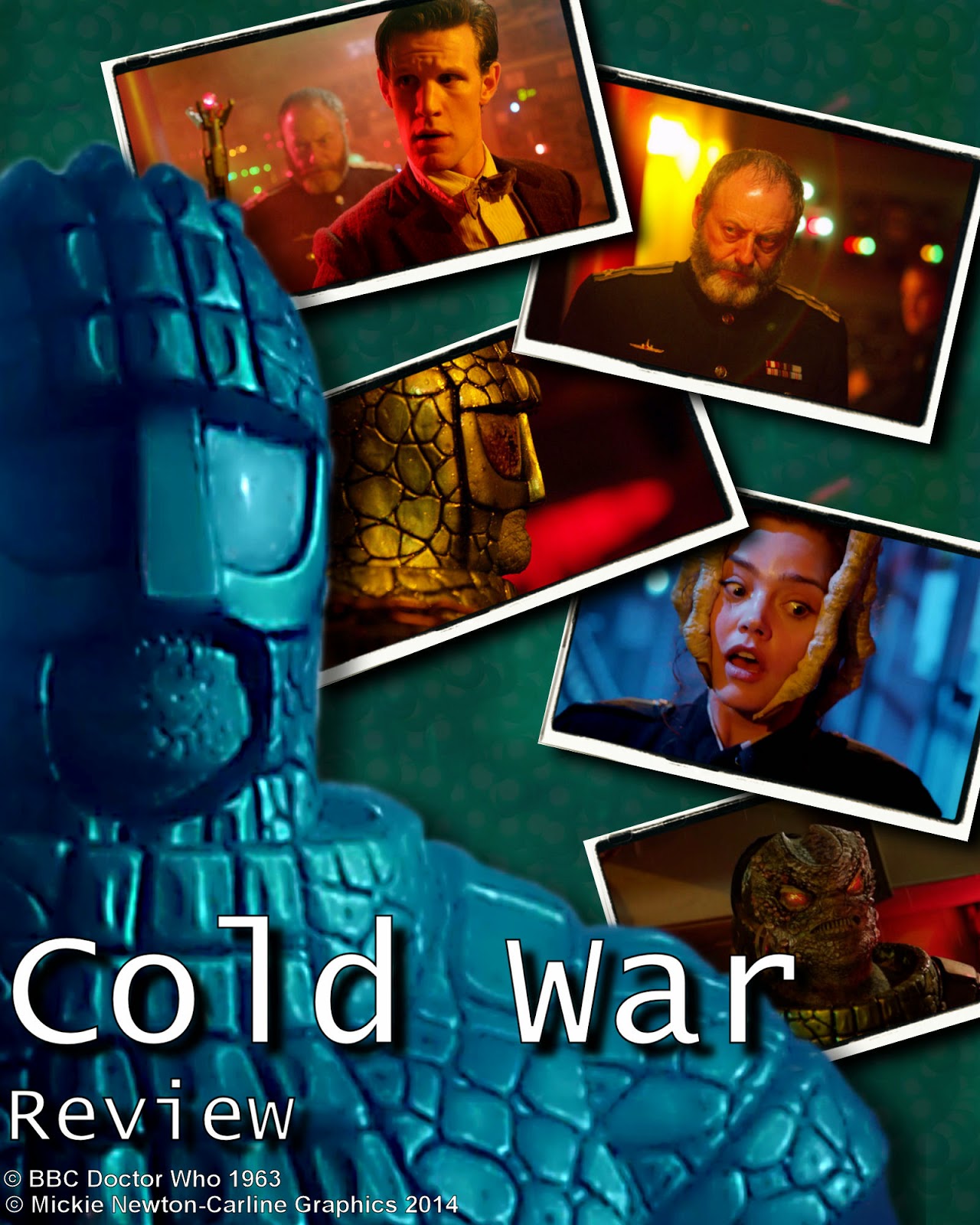
Who Reviews Cold War Review by Steve Taylor-Bryant


Written by Mark Gatiss
Directed by Douglas Mackinnon
Broadcast 13 April 2013
Series 7
Reviewed by Steve Taylor-Bryant

A Soviet submarine in the early 80's begins to defrost an ice block it believes contains a Mammoth but it contains something much more evil. The submarine starts to sink and the defrosted creature escapes as the TARDIS materialises and a surprised Doctor and Clara stumble out to find they are not in Las Vegas where they were actually heading. The Doctor quickly gets his bearings and convinces the crew to take the submarine sideways to prevent a crash and a nuclear explosion.

The Doctor comes face to face with his old enemy The Ice Warrior in the guise of Grand Marshall Skaldak and begs the Russian crew to act in peace but one of the officers attacks Skaldak. With revenge being on Skaldak's mind, the Doctor and the crew chain up Skaldak whilst the Doctor tries to work out the next move. Skaldak activates a homing beacon knowing his race will find him.

Clara volunteers to talk to Skaldak and, with the Doctor’s words, explains that he has been frozen for five thousand years. Skaldak is sad for the loss of his people and in particular his daughter and escapes his suit. Martian law means the whole of humanity is responsible for an attack on the Ice Warrior and he arms the nuclear weapons ready to destroy the Earth. An Ice Warrior ship appears above the surface, pulls the submarine up and beams Skaldak aboard. In one last attempt at peace, the Doctor begs Skaldak to spare the humans and eventually Skaldak disarms the nuclear payload.

I was so excited to see the Ice Warrior come back into Doctor Who. The last time they had appeared on screen was 1974 and I was still a year from being born, so it had been a while. I am also a huge fan of Mark Gatiss and thought such a fan of the legacy of Doctor Who would produce something epic. However, I was very wrong and left disappointed with what was essentially a Dalek rewrite. The chance to do something special with a classic villain of the older days of Who was surely missed.

©BBC Doctor Who 1963