Showing posts with label The Twelfth Doctor. Show all posts

Monday, 6 July 2020

Who Reviews Empress of Mars by Matt Rabjohns


I had a hard time taking to the stories during Matt Smith's era. I found several of them way beyond confusing and I'm afraid for a long while I stopped actually watching the show because I was becoming increasingly disillusioned with it, to say the very least. However, I was willing to give the show a go again when I heard a new companion was coming on board, this time in the form of Clara Oswald. I thought maybe new companion, new freshness. I wasn't completely wrong I am glad to say. Cold War gave us perhaps the very best modern era reproduction of a classic Doctor Who villain. The Ice Warrior. I thought the new design for once actually did honour the originals of the classic era!! The Ice Warriors were back, and back with some force.

Then it takes a long time for them to come back once more. The next time it is to be with Peter Capaldi and Pearl Mackie and Matt Lucas. I am at last elated that we are again to have another Ice Warrior story. I am even more elated to see that the story is going to be written once more by Mark Gatiss. To my liking Mark has always been one of the very few reliable new era writers in that I have actually at least enjoyed every one of his scripts for the show. He has a firm grasp of Who lore and even if his stories don't always boast anything wildly new or ground-breaking, they at least are always very entertaining and never slack in the slightest.

There are several firsts for the Ice Warriors in this new story. The biggest and most brilliant first is this is the first time we get to see a female Ice Warrior. This is absolutely a brilliant decision. And to be quite honest, Iraxxa is meaner looking than any of the male Warriors. Adele Lynch is absolutely superb as the Warrior Queen. She gives the role three dimensions, and also makes her a Warrior who does still actually possess a heart in that she seems to find that despite the ferocity of the Victorian soldiers stranded on Mars, that in Bill not all humans are so keen to perpetuate war and slaughter and so she begins to see more to humanity and is finally merciful, therefore a Queen of true stature and morality.

The other thing that is new, and that is a bit on the gruesome side, is the new weapons given to the Ice Warriors. They now have more than just sonic guns, but guns that when fired turn one into a square of hideously compressed flesh. This is totally unappetising and horrific to me, but looks so bold and explicit on screen. It is a nasty presentation of a way to die.

I do however have one major problem with this story. I wonder how it would ever realistically come to pass that a soldier who was once hung for cowardice would ever be given the command of a regiment. This to me does totally not ring true. I do not think this would ever have been allowed in the Victorian era. Or in any era of the British Army. Having said this though, Anthony Calf is superb as the shamed but in the end redeemed Godsacre. He truly sells the part very well indeed and deserves all praise for his take on a demanding role. He seems to manage to carry it off with absolutely ease.

Also I am not a fan of the limiting of Nardole to a few scenes in most of the series ten episodes. It is a total waste of a brilliant and fun character, wonderfully brought to vivid life by Matt Lucas. I really love his character but I can’t help but feel that on the whole he was truly wasted as a companion, his only significant hour is in the series finale. But even despite his diminished stance, when he's present you wonderfully and amusingly know he is there for sure. I wouldn't mind seeing Nardole return to the series again in the future. There was such a lot of potential in his character I feel.

But I do however really like the idea of the Doctor trying his best to show Missy the era of her ways. And Michelle Gomez is wonderful as ever as the none too trustworthy evil Mary Poppins from Gallifrey. She is so good to watch on screen. And to see maybe her at last seeing something wrong with her approach to life is a brilliant stroke of development for the character who has long been a stalwart of the history of Doctor Who ever since the first appearance of Roger Delgado in Terror of the Autons. The Master has come a long long way since then.

Pearl Mackie I can't help feeling is rather like Martha Jones as a character. in that she gets flashes of very good character displays, but somehow, she still feels so much like a spare part. I feel this is unfair to Pearl as she clearly can act and she's very, very good at it too. It's just she seems to always be on the outskirts of stories, and never really contributing anything massively brilliant to the show. In fact, I can only think of The Pilot, Thin Ice and the Cyberman epic two parter where she finally gets the screen time and development she truly deserves. In the Empress of Mars though she does get to have some good scenes with the Empress when she asks her advice on the matter of what to do with the human soldiers stranded on her planet. So, all credit again to Mark Gatiss for at least trying to give Pearl something decent to act out within a story.

Asides from the major plot point I mentioned though, I really did enjoy this superb story. It is perfectly paced; it is not overburdened with sub plots galore and the acting all round is extremely good. The Empress of Mars surpasses Cold War in every respect in my opinion.

And one more instance of true fan joy is the return of Ysanne Churchman as Alpha Centauri in her cameo at the end of the story. It is utterly brilliant to hear from the wonderful Ysanne again, and she has not changed at all. This is the icing on the cake of a story that delivers on almost every front. Ysanne Churchman as the brilliant delegate from Alpha Centauri was just amazing to view again on screen after so many years after the Monster of Peladon. This story goes on to tie in to the events of The Curse of Peladon!

In fact, I probably would go as far as to say this is my absolute favourite Mark Gatiss script of all for the modern era. It is a really engaging and really well directed story. Wayne Yip deserves all commendations for his taught, tight and superb piece of cinematic Doctor Who.

And Peter Capaldi? Well what does one need to say about his performance other than he is easily and always will be my favourite male Doctor of the modern era by a clear mile and half...


Tuesday, 4 February 2020

Big Finish Reviews+ The Best - Laid Plans by Tony J Fyler


Tony has a good idea

Where do you get your ideas from?

It’s a question writers get asked all the time. Politicians and dictators rarely get asked the same question but seem determined to tell everybody at length in memoir after memoir after interminable memoir.

People have a tendency to assume everyone gets their ideas from some individual place in their brain. But imagine, just for a moment, that’s not the case.

Meet Dracksil Forg, idea salesman. For the right price, he’ll imagine you any darned thing you want, from the plot of a major blockbuster novel to a way to crush your local star system under your boot heel. The plans will be detailed, precise, not always easy but always, always, foolproof. If you follow Dracksil’s recipe, you’ll get the result you want.

Every time.

And the best bit is that he’s strictly an ideas man. Strictly a service industry. Not for him the ethical qualms of an activist. He merely solves any equation you bring him for X, where X is the desired result.

Dracksil Forg is a gorgeous idea in the Doctor Who universe because he’s not, in himself, evil, but he is, or at least seems to be, a kind of anti-Doctor, a profit-incentivised version of our favourite Time Lord. Where the Doctor goes careering through time and space, fixing random problems he encounters, Dracksil Forg sits perfectly still in his own time and space, and waits for problems to walk through his door. For the right amount of money, they leave with a solution. The cosmos changes as a result of his actions, but Dracksil Forg is like a ghostwriter – he never puts his name to the actions that ensue from his plans, but those who need him will know his name.

Except…

Except he’s started to come to the notice of someone else. Some lanky, grumpy beanpole with fighting eyebrows and a runaway mouth. Some would-be legend who, for instance, when paid to poison a particular dignitary at a dinner, somehow manages to ensure they go home remarkably unpoisoned. Someone who when faced with a drone army of killbots reprograms them to pick plastic out of the oceans instead. Someone who when he encounters a cut-price quantum Death Star…waves a screwdriver at it and turns it into a planetary vending machine.

The Doctor.

Very specifically in this instance, the Twelfth Doctor, as voiced by Jacob Dudman. The story is essentially a shedload of set-up and bedding in, a handful of examples of how the Doctor is causing, shall we say, radical customer dissatisfaction on the part of Dracksil’s latest clients (Can you imagine the reviews? Nobody wants to have an army of killbots turn green crusader on them just after they’ve issued their proclamation of power, it just makes you look a pillock), and then a build-up to one of those confrontations in which the Twelfth Doctor particularly excels. When Dracksil and the Doctor face each other in Dracksil’s office (like everyone else, the Doctor has to come and see Dracksil, rather than vice versa), what we get is an immensely satisfying confrontation, not because of any raised voices – the Twelfth Doctor is often most effective when he lowers his voice – but because it absolutely shines with pure distilled Twelfth Doctor tones. There’s a left-field beginning, that seems there just for the fun, but isn’t. There’s an explanation of what’s really going on, opening Dracksil’s eyes to a truth even he has never worked out about himself. There’s a fairly casual insult or two, because, after all, this is the Twelfth Doctor. And then there’s the hope. The Twelfth Doctor’s hope that the universe can be better than its default setting of grim and grasping nastiness if it just dares to be imaginative. If it dares to use its little pudding brains, and can find the better way to be. Pudding, not poison. Greenbots, not killbots. Hunger-ending vending machines, rather than planet-blasting death machines. Think, is the Twelfth Doctor’s main theme. Think. And then be kind.

Ben Tedds won the 2019 Paul Spragg Memorial Opportunity with this story, and it’s easy to hear why. The imaginative leap involved in inventing Dracksil Forg is the kind of blow-your-hair-back brilliance that seems obvious once it’s been done, but which takes a very particular energy of mind to actually invent (arguably in itself pre-empting the theme of the story). The notion of Dracksil’s business – a kind of ‘We can imagine it for you wholesale’ service industry, dealing with its clients at a long business distance speaks to both great science fiction, in the lines of Philip K Dick and Douglas Adams, and to our real world service industries today who, when things go wrong, scuttle away with their hands raised and claim it was nothing to do with them. You could arguably draw a line between what Dick did for memory and perception in We Can Imagine It For You Wholesale and what Adams did for faith and belief with his electronic monk in Dirk Gently’s Holistic Detective Agency, Tedds does here for the creative imagination – he farms it out to a service provider, irrespective of what the intended goal might be, and Dracksil Forg is that service provider. It’s an idea that absolutely has legs in the New Who universe, and you can easily imagine how the premise and the examples of the Doctor’s plan-thwarting could have been expanded to fit a whole TV episode.

It feels like Tedds knows his expanded Who-universe, giving us a kind of Easter egg here in the form of a bird-people species from the local cosmic area of the Shansheeth, only where the funeral directors were vulture-people, Tedds gives us legal…ach, you can probably work out which birds he has working heavily in the legal profession. No?

And above all, the spirit of the Twelfth Doctor sings out from the ending of this story. He’s not against people having ideas. He’s not even against people paying someone else to have their ideas for them. But he wants to collapse the callous disregard Dracksil’s allowed himself to have for consequences, arguably echoing the ‘guns don’t kill people, people kill people’ line of the likes of the NRA in our modern world. Guns absolutely don’t kill people if no-one has the idea for guns, and the people who do have the idea for guns can’t be separated from the consequences of their ideas. Likewise, the Doctor argues here, people who have the idea for planet-killing weapons or drone armies need to face up to the consequences of the ideas they have, and the ideas they sell to a hungry marketplace. Especially when kindness and imagination will allow them to have better ideas. Kinder ideas. Ideas that make the universe a better place, rather than a deader place.

It’ll be interesting to see where Tedds’ career goes from here, but wherever it is, it’ll be worth watching. And any time he gets another Big Finish gig, you’re going to want to pre-order that thing, because The Best-Laid Plans punches well above the weight of a new author Short Trip, weaving some fairly hardcore sci-fi philosophy into the carpet of a thumping good adventure story with some pitch-perfect Twelfth Doctoring to give you a shot of Old Attack Eyebrows that feels like it could have been lifted straight from the screen. The best-laid plans may aft gang wherever they like, but make getting a copy of this story the best plan you lay today and you’ll end your day with a Twelfth Doctor smile. Guaranteed by Dracksil Forg.

Thursday, 4 January 2018

Who Reviews Twice Upon a Time by Jeffrey Zyra


Written by Steven Moffat

“Doctor, I let you go.”

The 2017 Christmas Special is here and it is a historical one that will be remembered more for the debut of Jodie Whittaker than for Peter Capaldi leaving Doctor Who along with Steven Moffat.  This year’s special is also a little bit more special as it also stars David Bradley as the First Doctor, taking the reins from the late William Hartnell, to join forces in a rare multi Doctor story.  Needless to say, this story has a full complement of characters.  Oh, did I mention that Bill returns in this story too?  Yes, she pops back also as Peter Capaldi is joined once again by Pearl Mackie. 

The story takes place right after the closing moments of “The Doctor Falls” when the two Time Lords meet up at the closing moments of “The Tenth Planet”. So that is two stories closing moments that have a part in “Twice Upon a Time” and one is the story of the first regeneration as we see the First Doctor doubting if he wants to regenerate. Sort of what the current Doctor is going through except he is thinking of ending the cycle and just die and end the line of The Doctor. 

So that is where the story starts to take place when we see the two Doctors talking together and all of a sudden time stops.  Nothing is moving at the Antarctic at all well except for a British Captain from 1914 during the First World War.  It is during this exchange with The Captain that the story starts to pick up as the three men who are now inside the TARDIS are captured by the glass looking aliens called The Testimony.  The Testimony are from the future and come and collect a vital part of the human when they die and now they want The Captain to be brought back to when he dies to ensure the timeline to be where it should be.  As you can imagine this doesn’t set well with The Doctors and of course the plan to stop it along with Bill who just happened to appear from nowhere on the Testimonies ship.   As we soon discover once The Doctor arrives on an unnamed planet to ask for the help of Rusty Dalek the Testimonies have not committed anything evil in fact from the invention of Dr. Helen Cray of New Earth they take the memories from those who have passed away and put them in an avatar to speak with their loved ones in which we find out that Bill is one of those avatars. 

Which takes us to the conclusion in which The Doctor changes the rules again and The Captain is saved.  It turns out The Doctor lands the TARDIS a few hours after The Captain left and returns him right at the moment of the 1914 Christmas Truce where both sides stopped fighting on Christmas Day - something that has never happened again in any war and is one of the true miracles of Christmas.  This actually happened and there are many books on the subject and also a movie so if you have the time you should check out and learn about what happened on December 25th 1914. 

“Twice Upon a Time” wasn’t all that bad of a story.  I had my reservations about it as the current string of regeneration stories in the newer Doctor Who have had a bad track record. Stories like “The Time of the Doctor” and “The End of Time” were cluttered with lots of characters and stories that didn’t make all that much sense at all.  Though the farewell in “The End of Time” is one of my favorites I can’t say all that much for the actual story. But thankfully with Peter Capaldi’s last story we are given a story that is very enjoyable and makes sense. What we have are two characters at a crossroads on whether they want to go on.  Both Doctors are questioning the regeneration process and it takes one last adventure and to help a soldier, who happens to be Brigadier Lethbridge - Stewart’s relative to shake them from their doubt. Everything else in the story was frosting on the cake as it was mainly a story about their own mortality.

I really liked the pairing of the First and Twelve Doctors but Steven Moffat didn’t really capture the essence of the First Doctor.  He didn’t write him all that well and at times I was shaking my head at what he was saying.  I know the 1960’s was a different time but the First Doctor wasn’t as sexist as he was portrayed in “Twice Upon a Time”.  In fact he never mentions to his female companions to clean the ship and stuff like that but instead he is seen as a grandfather type to Susan and Vicki.  If there was a low point of “Twice Upon a Time” it had to be the way Steven Moffat characterized the First Doctor. 

I did like having Bill being an avatar of her memories. It made the farewell scenes all that much better as we didn’t have The Doctor traveling back to see his former companions or hallucinate seeing Amy or anything like that.  It made perfect sense and was the right thing to do seeing his old companions as memory avatars.  It was also good to see Jenna Coleman return as Clara and have him get his memories of her back. With her and Nardole return was a nice touch and very a touching farewell as they help persuade The Doctor to keep on living. 

I really enjoyed Peter Capaldi as The Doctor.  Like most I was sad to see him go and was glad he got a good send off.  I really liked the speech he gave before he regenerated.  It was like a lecture for the next incarnation on how to act as The Doctor and what it means to be The Doctor.  It also wasn’t mushy and sappy and you didn’t have crying Doctor saying goodbye.  His last words were like he was letting the part he enjoyed and handing it off to Jodie Whittaker.  It just seemed to me like a passing of the torch type of moment and a pretty simple goodbye.

We also get our first glimpse of Jodie Whittaker and it appears we are recycling another cliffhanger as we have seen something similar before when Matt Smith took over from David Tennant.  It would have been better if they came up with something else but I’m guessing we’ll find out in time when the show returns in the Fall.  So in the words of the new Doctor this story was brilliant and a very good send off for Peter Capaldi and one of the better Christmas Specials and Regeneration stories in the new series.
Grade B+

Thursday, 6 April 2017

Who Reviews The Twelfth Doctor Vol #1 Comic Book Review by Tony J Fyler


Tony Fyler gets stuck into the collected works.

The first collected Volume of Twelfth Doctor stories from Titan Comics is just ridiculously good. Sorry, but let’s take a leaf out of the brusque Doctor’s book and cut to the chase: just go and buy it now, then come back and we can read along together, it’ll save time.

Calling it a collected volume might come across as just a little cheeky, given that there are just two stories, but one of them’s The Swords of Kali, so you’re getting a good deal before we even get to the first story, Terrorformer.

In terms of stories, Terrorformer’s a bit of a mish-mash – it’s what happens if you smash the Tenth Doctor’s 42, The Hitch-Hiker’s Guide To The Galaxy, a dash of Robots of Death and an episode of Red Dwarf together. If that sounds like it shouldn’t work on any level, we’ve misled you – it does work, but it’s simply solid, rather than staggering or exceptional. That said, the pre-credits sequence here, which is where Robots comes into play, is superb and chilling and the kind of thing that you’d pay good licence fee money to see translated onto the TV screen. The story itself is a straightforward ‘luxury custom-built planet’ idea – thank you, Douglas Adams - where the terraforming goes nuts because Something Else is controlling the process, to the chagrin of those who think they’re controlling it – thank you, Red Dwarf.

There are some neat, original, horrifyingly believable touches along the way in Robbie Morrison’s story though – animals with copyright marks on their skin is the gruesomely efficient and logical end-product of the kind of marking and tagging the human race currently does to dairy herds to identify animals belonging to one farmer or another – and the dialogue between the Twelfth Doctor and Clara is first class. There’s a chance some readers will find it all a bit of a re-tread of some David Tennant stories when it flings them into a backstory of ‘Big Bad versus an old-time alliance led by Rassilon of the Time Lords’ (the Tenth was a Doctor who seemed especially beset with grisly enemies that had previously led wars against the Time Lords, or had come from ye olde times – Carrionites, Racnoss, the Beast etc), but the storyline is well constructed, and the solution nicely technological, for all it ends a little abruptly. Anyone familiar with Morrison’s work from the likes of the Tenth Doctor masterpiece, The Weeping Angels of Mons, will know he has a very special knack for honing in on the core character of his particular Doctor, and managing both to deliver a pitch-perfect version of the Doctor you know from the screen, and to extend that version in subtle ways, so you end up with a comic-book adventure that feels very televisual, but often with better budgets and visuals. There’s no sign of that slackening in Terrorformer, though in all fairness, it would probably be a viable mid-season episode, better than a Kill the Moon, but not quite an (insert your favourite episode of the always-contentious Series 8 here).
On the subject of those better budgets and visuals, there’s good work in Terrorformer from Dave Taylor and Mariano Laclaustro, helping to give the story a scope and a pace that feels very Twelfth Doctor, very much always moving forward, even during flashbacks. So – good story, great Doctor-Clara dialogue, and art that helps push the pace forward while, when given a newly terraformed planet to envision, also giving us plenty of pretty multi-coloured things to look at. Where’s the bad?

That would be ‘nowhere’ you’re thinking of.

And then, as if that wasn’t enough, then comes The Swords of Kali.

The Swords of Kali’s in a whole other league in terms of the big ticks it deserves. Unusual settings – India, in the past and future – big tick. Really sharp – no, really, really sharp artwork and a use of colour that’ll make your eyeballs want to thank you for buying it – big tick. A number of genuinely innovative set-pieces, including a monster chase that exceeds the bounds of the strip’s panels, and a Clara cliff-hanger panel that should be a poster, right now – big tick. Tom Baker – big tick. A lesbian love story, and evidence of the progress of humanity over time in its social grooviness about that love story – big tick. Genuinely creepy monsters, particularly when ‘doing a Silence’ and hanging from the ceiling – big tick. Spot on Capaldi Doctoring, and a chance for the Twelfth Doctor to define himself in a way he only managed once or twice across his whole first on-screen series – ‘Man loves woman. Man loves man. Woman loves woman. Who cares? People hating each other, that’s what bothers me. That’s when the trouble starts.’ – Big ti- Note to self: get a bigger box of ticks next time we review Morrison’s work.

As we mentioned at the start, if you enjoyed Peter Capaldi’s Doctor on screen, you’re going to love the collected Twelfth Doctor Comics, Volume 1. If you weren’t sure, or still need convincing, there may well be enough expansion here to help seal the deal. Only if you happen to be a Claraphobe should you avoid this collection – she’s rendered very clearly in these stories as played by Jenna Coleman – the chirpiness, the smart-alecry, the ongoing backchat to the older incarnation of the Doctor, it all comes screaming across from the TV version, and she’s a big enough part, certainly of The Swords of Kali, for a dislike of her to ruin an otherwise gorgeous combination of tight writing and superb artwork. Personally, we say go for it. The first collection is a combination of a solid mid-season story and a tightly epic marvel that will repay your investment with multiple re-readings.

Thursday, 15 October 2015

Who Reviews Before the Flood by Jeffrey Zyra


Written by Toby Whithouse


“Clara, I want to talk to my ghost self.”

The problem with two part stories in the new version of Doctor Who is that the second part for the most part has been disappointing or at the very least pretty mediocre and has not delivered on the excitement from the first part that got you all jazzed up for the conclusion.  So far in the Capaldi era the two parters have been mixed with the mediocre Dark Water/ Death in Heaven to the very well done The Magician’s Apprentice/ The Witch’s Familiar.  Before the Flood has the hard task of following the really good Under the Lake and despite not being quite as good as its lead up episode it wasn’t bad at all and was pretty entertaining.

Before the Flood starts off with one of the more confusing segments to start an episode.  At first I was ‘what the hell does this have to do with anything and who cares about Beethoven and that stupid guitar’.  I just did not care and wanted to know more about the ghost Doctor and what would happen to Clara and the others in the seas base.  Well that scene in a clever but annoying and confusing way explained how The Doctor escaped from the Fisher King and well did we really need that explanation at the beginning?   Maybe, but the explanation went by so fast that I had to watch it again.  It made sense the second time around but at first watch it was confusing.

I really enjoyed Before the Flood but did not think it was as good as Under the Lake.  While Under the Lake was scary and had a lot of tension that was missing from Before the Flood.   Before the Flood was not all that scary and was turned into a time travel story.  Yes, the scene with Cass walking in the corridors was a tad scary but you had a feeling that she would figure out that a ghost was behind her.  That scene reminded me a bit of Daredevil when he used his powers to sense that someone was there.  The scenes with the Fisher King screaming and chasing The Doctor, O’Donnel and Bennett were pretty good also and had a touch of Hinchcliffe to them.

Clara is starting to act too much like The Doctor and it is getting annoying.  I mean when she forced Moran out to get the cell phone back from the ghosts because he wasn’t infected was a good idea but who is she to order him to get it.  Yes, he went because he knew it was the right thing but I did love how Cass called Clara out on that.  Something she needed and it almost ended up getting them all killed.  Also she came across very selfish telling The Doctor to die with the next companion after her.  That’s pretty cold and selfish especially when The Doctor finds out about his upcoming demise.   That did not paint Clara in a good light with me and thankfully she will be leaving soon.

One of the things that bug me is the new sonic sunglasses.  The plus thing is that The Doctor doesn’t wave it around like a magic wand to save the day but it is starting to become a safe way out.  I get how he used it to make the hologram ghost of himself and all that but what bugged me is if he could use the glasses to erase the imprint from everyone’s eyes why didn’t he do that earlier?  Wouldn’t have made things simpler when he figured out what the words in the ship did to you.  It would have made you immune from the ghosts and you wouldn’t have to worry about them anymore.

I did like the way The Doctor saved the day even if it became predictable.   I had an inkling that The Doctor would be in the statis chamber as the clues were there especially with the TARDIS being freaked out about being at the sea base.  It became even more apparent when The Doctor confronted the Fisher King.  It was a pretty good solution and even though you didn’t see The Doctor set the charge for the dam or set up the TARDIS emergency takeoff  it made sense as we knew only one power cell made it to the future and the dam does break.  The way The Doctor tricks the Fisher King is right out of Classic Who as The Doctor used his intelligence and his words against the enemy and not weapons.  

Before the Flood had a classic feel to it but just wasn’t as scary or clever as Under the Lake.  It was pretty entertaining and I really did enjoy it even though I had some problems with it.  It had a classic Doctor Who feel to it and even though they tried to be way to clever with the explanation of how The Doctor cheated death it wasn’t really needed as The Doctor could have explained all that to Clara at the end.  But still Toby Whithouse gave us a two part story that was really good and very entertaining and it did escape the New Who two part story curse.
Grade B+


Wednesday, 30 September 2015

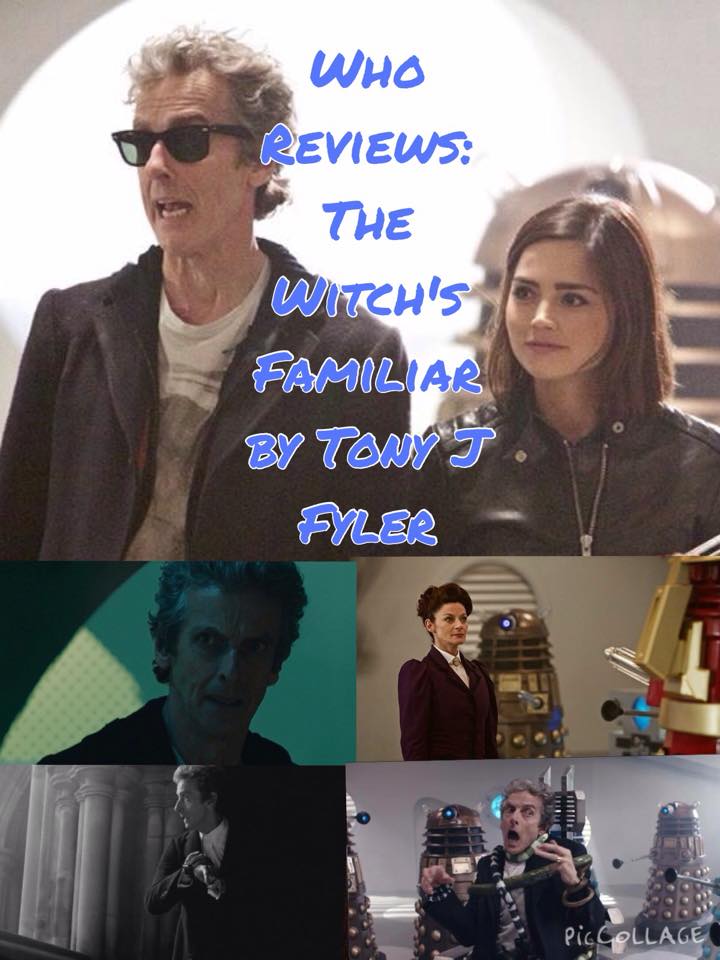
Who Reviews The Witch's Familiar by Tony J Fyler


Oh look, surprise, still not dead, says Tony Fyler.

As false cliff-hangers go, there are those that make you genuinely wonder, and there are those that overplay their hand.

The Magician’s Apprentice…well let’s just say at the end of the episode, my non-Whovian but long-suffering wife turned to me and said ‘I don’t buy that for one second.’ The Moffatty timey-wimey no-one’s-ever-really-dead-ness is strong in this one.

When you push the stakes too high, you’re left with either an RTD-style deus ex machina, or something enormously convoluted and clever, or you’re left with ‘I’m the Doctor, just accept it,’ as a way of carrying on beyond the point of ultimate cliff-hangery.

So Missy’s not dead, Clara’s not dead and off they jolly well pop, allies with a pointy stick against the heart of the Dalek empire. The pre-credits sequence of The Witch’s Familiar has a sense of existing merely so Missy can be enormously…Missy about things, and in terms of drama, it’s not a patch on The Magician’s Apprentice’s pre-credit sequence, but it does at least take the trouble to explain both the deus and the machina not only of why she and Clara are not dead from Dalek weapon fire, but also why she didn’t die at the end of Death In Heaven. And with that, and with the weirdest alliance forged, off they skip, with nothing but a pointy stick and some self-belief, to take on the Daleks.

In the heart of the Dalek city, the Doctor and Davros are reaching a crisis point, showing us something new – for all he’s got a reputation of being a grumpy Doctor, Capaldi’s Twelfth hasn’t done outright rage very often, but here he’s pointing a Dalek gun at Davros’ head, not solemnly as the Fifth Doctor did it, but angry, furious, demanding – leading to one of the best sequences in recent years, which will probably be forever known as the “Anyone for dodgems?” sequence. Ultimately though, the Doctor’s faffing about in Davros’ chair doesn’t achieve much in story terms, and it’ll be interesting to see whether Capaldi’s favourite scene of the two-parter stands up to the test of time. There’s a sense in which the whole “Of course the real question is where did he get the cup of tea. Answer: I’m the Doctor, just accept it” could be taken as a one-finger salute from Moffat to all the fans who take life too seriously, and/or those who demand there be some logic in the storytelling. So – that’s us told, then.

Before long, we’re back in the dinge of Davros’ chamber, where the prevailing mood for the rest of the episode is confessional.  By contrast, Missy and Clara’s ‘hero quest’ into the Dalek city is mostly played for laughs, albeit sometimes, dark laughs with some solid characterisation, particularly of Missy – the face she makes while Clara’s hesitating to kill her channels at least Ainley and Simm, and possibly a little Delgado too, into the uniqueness that is the Gomez interpretation. The throwing of Clara into a potentially bottomless pit is telegraphed just a little too much to deliver the crisp laughs it’s looking for, but still, it underlines how Missy sees the universe. “Every miner needs a canary,” indeed.

Before it was open to the world’s scrutiny, those who’d seen the two parts tended to agree that most of the things that stopped it from ending up on the All-Time Classics list were in the second part, and for me, the whole Dalek sewers thing is one of them. It feels not only like convenient creation, but also a slightly unfortunate re-writing of Steven Moffat’s Curse of the Fatal Death, with the Master spending centuries crawling through endless sewers while the Doctor hopped back in time to assure his own ultimate victory. This time though it’s played for drama, rather than outright laughs. It’s also slightly unfortunate, when dealing with sewers, for the liquid that occupies the Dalek you murder to be brown. You can call it ‘decayed Daleks’ all you like, but on the playground, The Night of the Dalek Poo-Storm will be played out up and down the country.

It’s a concern that resonates of course in the ending, as the whole Dalek city is consumed by Dalek sewage. There are some really interesting lessons on the way – the incapacity of a Dalek to see anything outside its species as anything other than an enemy to be exterminated, the idea of them continually screeching “Exterminate!” as a way of recharging, which is genius. Missy’s goading of the Doctor to kill the Clara-Dalek is gloriously mischievous, and her notion of Clara being ‘the friend within the enemy, the enemy within the friend’ should be enough to start the fan theories roaring, particularly as regards the way she ultimately leaves the Doctor. But sewage – even Dalek sewage – still feels like an unfortunate image as it vanquishes the greatest pepperpots in the galaxy.

The meat of the episode, the conversation between the Doctor and Davros, is a pure fangasm in celluloid, and contains some of the best moments we’ve seen in New Who so far – including a quiet moment of self-definition by the Twelfth Doctor (“If I try, very hard, then on good days, I’m the Doctor, I’m not just some old Time Lord who ran away,”), and most surprisingly, Davros’ rationale for being happy that the Time Lords are back in the sky somewhere. That’s masterfully written, because it takes us back to Davros the man, Davros the Kaled, before the Daleks were even a reality in the cosmos. These two, talking like ageing citizens of a scarred and battle-weary cosmos is a thing of wonder, Bleach more than holding his own against Capaldi, and investing the scenes with a true equality, these two old men of the stars sharing memories and philosophies that no-one else would really understand. But along the way, there are unfortunate – if necessary – moments. The prophecy from Gallifrey is mentioned in about two lines, but it comes out of nowhere, with no foreshadowing whatsoever, and turns out to be the rationale behind Davros’ plans. The opening of Davros’ ‘real eyes’ is a moment that’s made more than some fans go ‘hold on a freakin’ minute – Davros has always had EMPTY sockets, hasn’t he? Not just closed, working eyes!’ We understand why it was necessary – it’s a sentimentalist game-changer, the old man, looking at his sunrise through his own eyes once more, and his being unable to do so works as the spur to the Doctor’s compassion – but it’s pretty much re-written for the sake of that moment what most fans have always understood about the anatomy of Davros. Presumably the angry mob is already on the march. But most of all, there’s the lost opportunity for impact. If Davros’ story had been true, all that wonderful work that was put into the conversation between him and the Doctor could have stood as a testament to the man who invented the Daleks. But having it all be a ploy to get the Doctor to re-invigorate him and the Daleks feels not only weak, but ever so slightly cheap as a way of ending the story. What’s more, we’re not really sure what it says about the Doctor – the Doctor who claims he wouldn’t die of anything but compassion, but yet was really masterminding a plan to destroy all the Daleks. It works in the context of storytelling, but there’s always going to be that after-image of the story that this could have been – the Death of Davros, the confrontation of age, and mortality, and philosophies and compassion standing as a last testament to the creator of the Daleks. As a grand strategy by Davros, and an even grander one by the Doctor, it actually loses quite a lot of its lasting impact.

Is The Magician’s Apprentice/The Witch’s Familiar absolutely great Doctor Who? Yes, undoubtedly. Will it attain all-time classic status? That’s a little more questionable, and it’s questionable for the most part because of elements in The Witch’s Familiar. It still bowls along, delivers plenty of thrills and fun and quiet wonder, but there was an opportunity in The Witch’s Familiar to turn the two-parter into something that could never be ignored, in the same way Genesis of the Daleks can never be ignored. The death of Davros would have made all the conversation between him and the Doctor honest, legitimate, the last hopes of a desperate, dying man, recorded and recognised by the closest thing he has to a friend in the universe. By choosing the path of clever planning, and delivering an ‘Aha! I knew your clever plan was a clever plan, and planned even cleverer!’ solution, what this two-parter ends up as is cracking Doctor Who and a great series-opener, but just slightly less immortal than it could, and perhaps should have been.


Still though – sonic shades? The Twelfth Doctor – what a dude!

Who Reviews The Witch's Familiar by Jeffrey Zyra


“You are not a good Doctor."

In Steven Moffat’s recent history his second part of two part episodes has failed to deliver. He does really well setting everything up in part one and giving us a cliff-hanger to talk over during the week but when we get the conclusion we are scratching our heads going that was it.  Yes, I have not been a fan of Steven Moffat’s two part stories lately as I thought Series 8 season ender was ok and better than normal but other than that he hasn’t done well with the second part since The Doctor Dances back in 2005’s Series 1. 

The Witch’s Familiar is the second part of the series 9 opener The Magician’s Apprentice and it has the tough job of explaining what happened to Missy and the Daleks and how will The Doctor escape from Davros.   Well Steven Moffat did a pretty good job answering these questions and in fact gave us a second part that was pretty good.   In fact I was surprised how good it really was.

I really liked the pairing of Clara and Missy.  It really worked and they seem to have good chemistry between them. I like how sinister Missy is and the fact that Clara does not trust her an inch.  That tension works well and helps with their part of the story as you are waiting to see what might happen to Clara like being pushed into the sewer.  That isn’t even the worst part of what happens to Clara.   Missy convinces Clara to get into a Dalek and act as her capture.  Missy has a more devious plan for this as what she really wants is for The Doctor to kill Clara.  With Clara in the casing when she says her name it comes out as “I am a Dalek.”  So The Doctor would not know it is her.  What a devious and evil plan that Missy came up with.  I was really impressed with this that I just thought it was brilliant.  What a devious way to get at The Doctor if he kills his friend and then when he finds out that he did it that revelation would absolutely destroy him.

What really made The Witch’s Familiar were the scenes with Davros and The Doctor.  In most of their stories they never really had much time to talk.  Sure there were the interrogation scenes and confronting the enemy, but they never really had any dialog together that was meaningful.   We get to see The Doctor and Davros talk about why they did what they did and you could see even though they are enemies they do have some respect for one another.  It was actually quite an emotional conversation as Davros acted like a man dying and wanted to see The Doctor with his own eyes.  Now that was creepy as I never thought Davros’ real eyes were closed but were not there.  It was, to me, creepy seeing two eyes in the black void where they should be. 

For the most part that part of the story was really good and even the part where everything came unravelled and it was all a trick by Davros to get The Doctor to use his regeneration powers to help give the Daleks ultimate power.    Ok.  The Doctor knew that was what Davros wanted and he also revived the Daleks in the sewers but did he really think that Missy would come to his rescue.   It did not look like that The Doctor was going to get free from the snakes in that machine so how was he planning on getting free?  It was a lot of assumption on The Doctor’s part for that part of the plan to work.  Just seem too convenient of a plot device for Moffat to fall back on but it did work and was just a minor thing like where did Missy get that rope from to tie Clara up with?  It’s just stupid things like that hurt a story a bit.

So I guess The Doctor has sonic sunglasses now.  He used them to activate the TARDIS’s return from using the HADS.  Nice touch doing that but come on sonic sunglasses.  It just seems that they are trying too hard to make this Doctor the cool Doctor.  I’m not sure about the sonic sunglasses but I am hoping that they don’t make this a recurring thing and that this was the last we have seen of it.

I liked The Magician’s Apprentice and The Witch’s Familiar as it was for once a story that was pretty dark and did not have to rely on the sonic screwdriver as a solution.  It was evenly paced and it told a story that you had to watch and pay attention to.  It had some really great moments none more so than when The Doctor saved the young Davros and instilled the meaning of mercy to him.  That was a great touch and was the main reason of saving Clara.   Steven Moffat surpassed my expectation and with only a couple of eye rolling moments he gave us a very enjoyable two part story to start off Series 9.  I’m hopeful that the rest of the season will follow suit and we will have a very enjoyable Season.

Grade A

Who Reviews The Magician's Apprentice by Jeffrey Zyra


“Davros knows. Davros remembers.”

After months of speculation and rumors The Magician’s Apprentice has arrived and Series 9 has now begun in earnest.  The episode opens up with a child who happens to have wandered into an area where there are hand mines and is trapped and can’t get out.   The Doctor soon appears and tries to help the child from the trap until he learns the name of the child.  He then leaves the child to his fate and leaves in the TARDIS.

We find out that the child is named Davros and all the mystery that we were exposed to in the prolog and the prequel have now come to fruition and we now know that Davros is the one behind what The Doctor is running from.  This was the great jaw dropping moment of the episode and surely one of the biggest surprises in the shows history.  Sure we had the whole Missy reveal of being The Master last season but we had a whole series to come up with theories of who she was and most of the fans were right.  But the reveal that the boy running in the battlefield was Davros was a pretty good surprise and wanting to see what happens next was high priority.  It’s too bad we had to sit through some really silly stuff to get to the confrontation.

I really liked how The Magician’s Apprentice started.  With the whole reveal and then with Missy asking for Clara and UNIT’s help to find The Doctor.  That was pretty good and I really liked how Missy knocked Clara down a peg.  She needed to be as she just came across too bossy and a know it all.  All of a sudden she became super Clara and was able to figure out technology to find The Doctor.  Best line of that Missy and Clara exchange was that she was the puppy.   I did like the chemistry Michelle Gomez and Jenna Coleman has.  It worked really well and made the whole search of The Doctor all that more entertaining especially when they were on the top of the castle wall watching The Doctor making a fool of himself. 

This brings us to the part I’m just not so sure about.  The whole party for The Doctor just seemed too silly even for Moffat.  Really a tank and playing the electric guitar in 1100’s England.   It just didn’t seem all that funny.  For one who is driving the tank and where is the amp getting electricity from to power itself?  I’m sure diehard fans will come up with a way he did it by making a remote control for the tank and jury rigging the tanks power supply to power the amp.  Yes in theory I guess he could have done this but was it really necessary.  The story was pretty good till this point with Missy not being way over the top but that whole sequence of the party until Colony Sarff shows up in all his snake goodness.

Now I thought Colony Sarff was pretty cool.  I enjoyed seeing this creature slithering around asking people where The Doctor was.  I enjoyed seeing the reveal of what he was and seeing all those snakes appearing wreaking havoc.   But there was a problem with all that.   If Bors was a Dalek agent and spent three weeks with The Doctor why did Davros have to send Colony Sarff to find him?  I mean I’m sure Davros knew this as he would have access to the Daleks computers as he is all powerful so why send the snake guy?  They obviously knew where he was since one of their agents was there.    Unless the snake bite transformed Bors into a Dalek agent.  Then does that mean the snakes are really a Dalek creation?  Who knows I could be over thinking this part and it is a minor thing anyway.

I really liked the confrontation between The Doctor and the dying Davros.  It seemed like a game of chess with both of them not revealing their winning move.  Davros did seem to have the upper hand on The Doctor.  I did like seeing all the old encounters with Davros on the screen in the room. From Davison voice to the unlimited rice pudding speech it was all there.  I love when the new series uses the classic series it is always nice to give a nod to the past to help people remember it and hopefully go back and watch those stories.   Speaking of The Magician’s Apprentice has a lot of influence from Genesis of the Daleks.   Davros has used The Doctor’s words against him and turned the table as we are to believe that The Doctor did eventually save Davros or Davros somehow escaped from the hand minds.  He uses The Doctor’s compassion against him and we will see what happens in The Witch’s Familiar.

Michelle Gomez was great as Missy especially when it was revealed they were on Skaro.   The look of horror really sold the reveal and you got a feel of the danger they were in.  She quickly changes when Clara and she are face to face with all the Daleks and she tried bargaining for her life which did not work.  This scene was made more for shock value as I doubt Missy and Clara were killed by the Daleks and I highly doubt the TARDIS was destroyed.   This will lead to a lot of conversations on Twitter and in Facebook groups which isn’t a bad thing for the show.   I didn’t mind this as we know they are not dead but The Doctor doesn’t and it is a good way for Davros to get at The Doctor.  This brings us to Peter Capaldi as he is so good at looking shocked and in horror.  His expressions while talking to Davros really made the last part of the story and really sell the cliff-hanger for the conclusion.

The Magician’s Apprentice was a really good opening story that did have some surprises that I wasn’t expecting.  For one the confession dial which will open up when The Doctor is dead.  Who knows where that will lead?  I did enjoy most of the story as it caught my interest and I’m really looking forward to what happens next in The Witch’s Familiar.  It really did set things up very nicely but what is with the episode titles.  I’m sure we’ll find up in the next episode.  I did not like the silliness like the 3d Missy head coming out of the view screen but that is the overly cuteness that Moffat likes and most of us roll our eyes to.